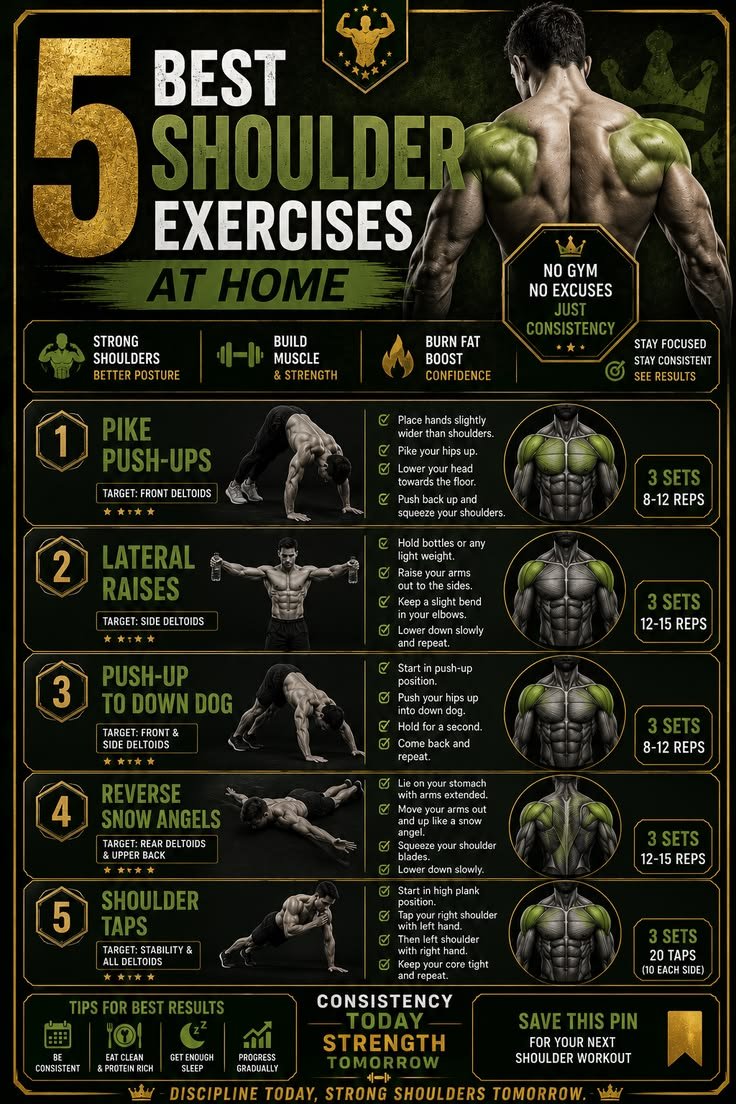
Shoulder exercises can be a useful part of a balanced home workout routine. Strong and well-controlled shoulders can help with everyday movements such as reaching, lifting, carrying, pushing, and maintaining good upper-body movement. You do not always need weights or gym equipment to work on shoulder strength. Many simple exercises can be performed at home using your own body weight.
The shoulders are involved in many upper-body movements, so they often work together with the arms, chest, back, and core. Because of this, shoulder training does not have to involve complicated exercises. Simple movements performed with good technique can provide a useful starting point for beginners.
1. Wall Push-Ups
Wall push-ups are an easy exercise for beginners and can introduce your shoulders to pushing movements.
Stand facing a wall and place your hands against it around chest or shoulder height. Keep your feet comfortably behind you and maintain a straight body position.
Slowly bend your elbows and bring your upper body toward the wall. Then push through your hands to return to the starting position.
Keep the movement controlled and avoid rushing. If the exercise feels too easy, you can gradually move your feet farther away from the wall.
2. Incline Push-Ups
Incline push-ups can work the shoulders while also involving the chest and arms.
Place your hands on a stable elevated surface and step your feet backward. Keep your body aligned from your head to your feet.
Bend your elbows and lower your chest toward the surface. Push yourself back up while maintaining control.
The height of the surface can affect the difficulty. A higher surface is generally easier, while a lower surface can require more strength.
Always make sure the surface is stable before using it for exercise.
3. Pike Push-Ups
Pike push-ups are a more challenging bodyweight exercise that places greater emphasis on the shoulders.
Begin in a position similar to a downward-facing triangle, with your hands on the floor and your hips raised. Your legs can be straight or slightly bent depending on your flexibility.
Bend your elbows and lower your upper body toward the floor while keeping your hips elevated. Then push through your hands to return to the starting position.
Start with a small range of motion if the exercise is new to you. You can gradually increase the range as your control improves.
4. Plank Shoulder Taps
Plank shoulder taps combine shoulder stability with core control.
Start in a high plank position with your hands under or slightly outside your shoulders. Keep your body stable.
Lift one hand and gently tap the opposite shoulder. Return the hand to the floor and repeat on the other side.
Try to minimize movement through your hips. The goal is controlled movement rather than performing the taps quickly.
If the exercise is difficult, you can perform it from your knees while maintaining a stable body position.
5. Arm Circles
Arm circles are a simple movement that can be included in a warm-up or light shoulder routine.
Stand upright and extend your arms out to the sides. Make small circles with your arms and gradually increase the circle size if the movement feels comfortable.
After several repetitions, change direction.
Arm circles should be performed in a controlled way. They are not designed to be an exhausting strength exercise, but they can help you move your shoulders through a comfortable range of motion.
6. Wall Angels
Wall angels can help you practice controlled shoulder and upper-back movement.
Stand with your back against a wall if the position is comfortable. Place your arms against or near the wall in a position similar to making a goal-post shape.
Slowly move your arms upward and then back down while maintaining control.
Not everyone will be able to keep their entire arms against the wall throughout the movement. Do not force your shoulders or arms into a position that feels uncomfortable.
Focus on smooth movement rather than trying to achieve a perfect range of motion.
7. Bear Plank Shoulder Taps
The bear plank shoulder tap adds a different challenge to the shoulders and core.
Start on your hands and knees. Lift your knees slightly from the floor while keeping your back relatively flat.
From this position, slowly lift one hand and tap the opposite shoulder. Return it to the floor and repeat on the other side.
Because your knees are elevated, your shoulders and core need to help stabilize your body.
If this feels too difficult, return to regular shoulder taps from a high plank or perform the movement with your knees on the floor.
8. Downward-Facing Dog
Downward-facing dog is a bodyweight movement that involves the shoulders while also moving the hips, legs, and upper back.
Begin on your hands and knees. Push your hips upward and backward while straightening your arms as much as is comfortable.
Keep your hands firmly connected to the floor and allow your head and neck to remain relaxed.
You do not need to force your heels toward the floor. The focus should be on comfortable movement and maintaining control.
This exercise can also be used as part of a warm-up or mobility routine.
9. Plank Hold
A plank hold requires your shoulders to help support and stabilize your body.
Start with your hands on the floor and your arms extended. Keep your body in a straight line while maintaining a controlled position.
You can also perform a forearm plank if that position feels more comfortable.
The goal is not to hold the plank for an extremely long time. Start with a manageable duration and focus on maintaining good form.
If your hips begin to drop or rise significantly, take a break.
10. Incline Shoulder Taps
Incline shoulder taps are a beginner-friendly alternative to floor shoulder taps.
Place your hands on a stable elevated surface. Step your feet backward and create a straight body position.
Lift one hand and tap the opposite shoulder. Return your hand to the surface and switch sides.
Because your hands are elevated, the exercise can be easier to control than a floor-based version.
As you become more comfortable, you can gradually use a lower surface.
11. Slow Pike Push-Ups
Once you are comfortable with basic pike push-ups, you can make them more challenging by slowing the lowering phase.
Start in your pike position and lower your upper body gradually. Avoid dropping quickly toward the floor.
Then push through your hands to return to the starting position.
The slower movement can help you practice control. You do not need to perform many repetitions for the exercise to be useful.
12. High Plank to Downward Dog
This movement combines two positions and requires the shoulders to work through movement.
Start in a high plank position. Keep your hands on the floor and push your hips backward and upward into a downward-dog position.
Then return to the plank position.
Move slowly and comfortably. Avoid forcing your shoulders through a range of motion that causes discomfort.
This can be included in a warm-up or as part of a bodyweight workout.
How to Create a Simple Shoulder Workout
You do not need to perform every shoulder exercise in one session. Select a few exercises based on your current fitness level.
A beginner might start with:
- Arm circles
- Wall push-ups
- Incline shoulder taps
- Plank holds
Someone with more experience might include:
- Pike push-ups
- Plank shoulder taps
- Downward-facing dog
- Slow pike push-ups
Start with exercises you can control. As your strength and coordination improve, you can gradually introduce more difficult movements.
Focus on Shoulder Control
Shoulder exercises should not be performed only for the number of repetitions completed. Movement quality is important.
Try to keep your shoulders controlled throughout each exercise. Avoid using fast, uncontrolled movements simply to finish a set.
For exercises such as shoulder taps, keep your body as stable as possible. For push-up variations, maintain a comfortable arm and elbow position.
If your form starts to break down, reduce the difficulty or take a short rest.
Warm Up Before Shoulder Exercises
A warm-up can prepare your shoulders and upper body for exercise.
Start with a few minutes of light movement. You can use arm circles, gentle shoulder movements, and easy wall push-ups.
The purpose of a warm-up is to gradually prepare your body rather than make you tired before the workout begins.
If you notice discomfort during the warm-up, do not ignore it. Choose a gentler movement or stop the exercise.
How to Make Shoulder Exercises More Difficult
You can progress without buying equipment.
One option is to move from easier variations to harder ones. For example, you might begin with wall push-ups, progress to incline push-ups, and later practice more demanding bodyweight movements.
You can also improve your control by slowing down repetitions.
Another method is increasing the range of motion when you can do so comfortably and safely.
Progress should be gradual. There is no need to move to a difficult exercise before you are ready.
Give Your Shoulders Time to Recover
Shoulder muscles and joints need recovery just like other parts of the body.
Avoid turning every workout into an intense shoulder session. You can alternate training days or combine shoulder exercises with other types of movement.
Recovery also gives you time to practice exercises with better technique during your next session.
If your shoulders feel unusually tired or painful, take a break rather than forcing another difficult workout.
Combine Shoulder Training With Full-Body Exercise
Shoulder exercises work well as part of a complete home fitness routine.
You can combine them with lower-body exercises such as squats and lunges, upper-body movements such as push-ups, and core exercises such as planks.
For example, a simple workout could include:
- A short warm-up
- A shoulder movement
- A push-up variation
- A leg exercise
- A core exercise
- Light movement to finish
This gives your body a wider variety of movements instead of focusing on one area during every workout.
Common Shoulder Exercise Mistakes
One common mistake is trying to perform difficult exercises too soon. Pike push-ups and other demanding movements require more strength and control than basic variations.
Another mistake is rushing through repetitions. Fast movements can make it harder to maintain good technique.
Some people also continue exercising despite discomfort. If a movement causes pain, stop and reassess it rather than trying to push through.
Finally, avoid believing that more exercise is always better. A balanced routine with appropriate recovery can be more useful than repeatedly training the same muscles.
Make Exercise Consistent
You can develop shoulder strength and movement control without complicated equipment. The most important starting point is choosing exercises that match your current ability.
Begin with simple movements, practice them regularly, and gradually increase the difficulty as your control improves. You can use wall push-ups, incline movements, planks, shoulder taps, and other bodyweight exercises to create a practical home routine.
If you are new to exercise or have a shoulder injury or other physical concern, consider asking a qualified adult, coach, or healthcare professional about appropriate exercises and modifications before starting a new routine.
Leave a Reply