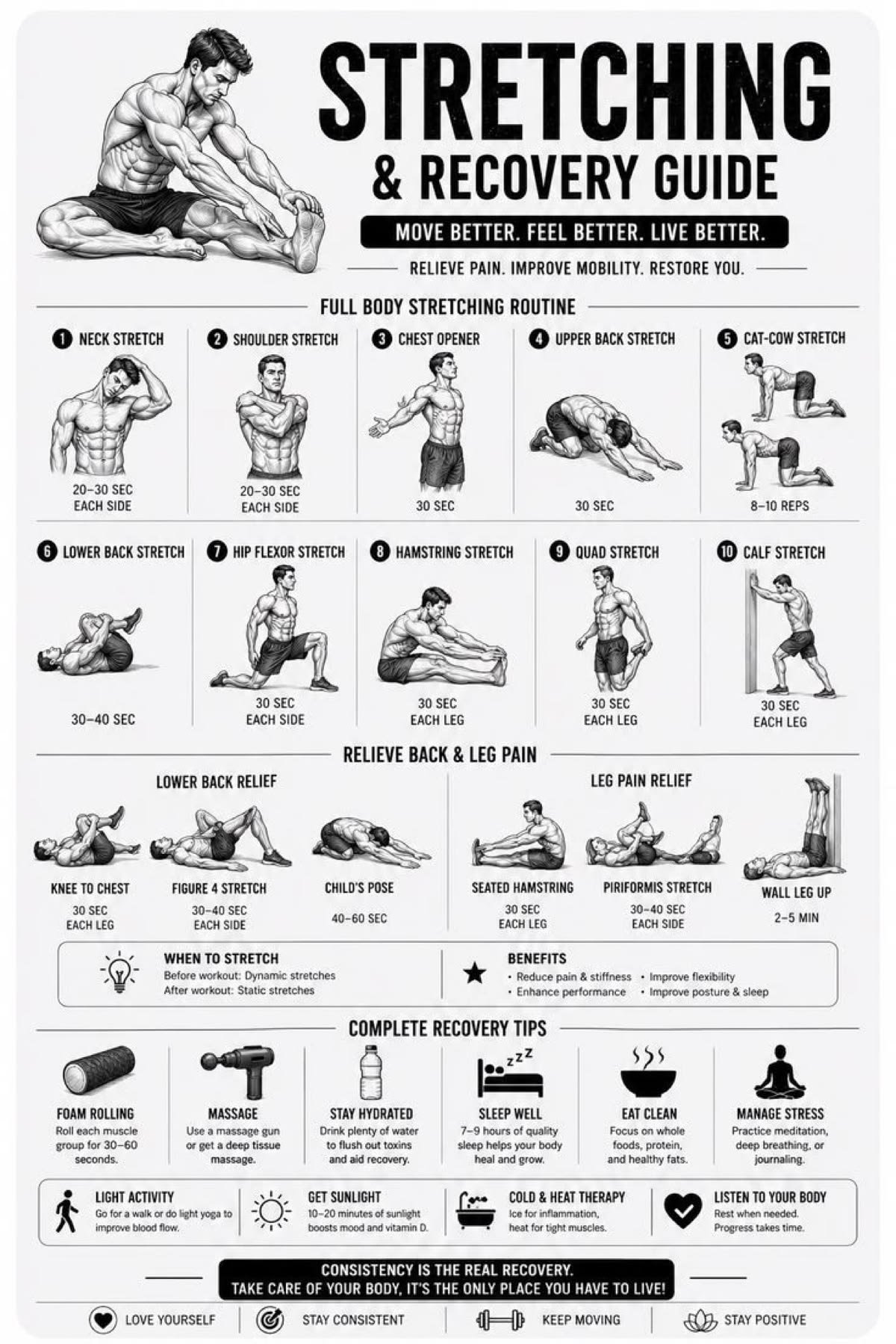
Stretching is a common part of many exercise routines. After completing a workout, spending a few quiet minutes moving and stretching can be a useful way to transition from exercise back to normal daily activity. It can also help you pay attention to how your body feels after movement.
Stretching does not need to be complicated. You can use simple movements that target the muscles you have used during your workout. The most important thing is to stretch gently and avoid forcing your body into uncomfortable positions.
Whether you exercise at home, walk regularly, participate in sports, or follow a strength-training routine, learning how to stretch appropriately can make your overall exercise routine more comfortable and organized.
What Is Stretching?
Stretching involves moving a muscle or group of muscles into a position where you feel a gentle lengthening sensation.
There are different types of stretching. One of the most familiar is static stretching, where you move into a comfortable position and hold it for a short period.
For example, after exercising your legs, you might sit or stand and gently stretch one leg at a time.
Another type is dynamic stretching, which involves controlled movement rather than holding one position. Dynamic movements are often useful before exercise because they help you prepare for activity.
After exercise, gentle static stretching can be included as part of a cool-down routine.
Stretching Can Help With Flexibility
One of the main reasons people stretch is to support flexibility.
Flexibility refers to the ability of your joints and muscles to move through an available range of motion.
Regular gentle stretching may help you maintain or gradually improve your flexibility when practiced consistently.
For example, if you regularly stretch your legs, you may become more comfortable performing movements that require a certain range of motion.
However, flexibility develops gradually. You do not need to force a stretch or try to achieve an extreme range of motion.
Stretching Can Help You Cool Down
After a workout, your body may still feel active and warm. Moving gradually into a slower activity can provide a natural transition.
You might begin by walking slowly for a few minutes and then perform several gentle stretches.
This creates a simple cool-down routine.
For example, after a home workout, you could walk around for two or three minutes before moving into comfortable stretches for the legs, hips, shoulders, and arms.
The cool-down does not need to be long or complicated.
Stretching Can Promote Body Awareness
Exercise involves many different movements, and it can sometimes be difficult to notice how your body feels while you are concentrating on completing a workout.
Stretching gives you an opportunity to slow down and pay attention.
You may notice that your shoulders feel tense, your legs feel tired, or one side feels different from the other.
This awareness can help you make better decisions about your next workout.
If something feels unusual or painful, it is better to stop and seek appropriate advice rather than forcing yourself through the movement.
Stretch the Muscles You Used
A simple way to choose post-workout stretches is to consider the exercises you performed.
If you completed a lower-body workout, you could focus on your legs and hips.
If you performed upper-body exercises, you could include gentle shoulder, arm, and chest stretches.
After a full-body workout, you can choose a few stretches that cover several areas.
You do not need to stretch every muscle in your body after every workout.
Standing Quad Stretch
The quadriceps are located at the front of the thighs.
To perform a gentle standing quad stretch, stand near a stable surface if you need help with balance. Bend one knee and bring your foot toward the back of your body.
Hold your foot only if you can do so comfortably. Keep your knees reasonably close together and avoid pulling aggressively.
Hold the position for a short, comfortable period, then switch sides.
If balancing on one leg is difficult, choose a seated version instead.
Seated Hamstring Stretch
The hamstrings are located at the back of the thighs.
Sit on the floor with one leg extended and the other leg comfortably bent. Keep your back relaxed and slowly lean toward the extended leg.
You do not need to touch your toes.
The goal is to feel a gentle stretch behind the leg, not to force your body into a deep position.
Switch sides when finished.
Calf Stretch
The calf muscles can receive a lot of work during walking, running, jumping, and lower-body exercises.
To perform a simple calf stretch, stand facing a wall and place your hands against it.
Move one foot behind you and keep that heel comfortably connected to the floor. Gently bend the front leg while keeping the back leg controlled.
You should feel a gentle stretch around the calf of the back leg.
Switch sides afterward.
Gentle Shoulder Stretch
After exercises such as push-ups or other upper-body movements, you can include gentle shoulder stretches.
Bring one arm across your body and use the opposite arm to support it lightly.
Do not pull aggressively.
Hold the position comfortably, then switch arms.
The movement should create a gentle stretching sensation around the shoulder and upper arm.
Chest Stretch
You can also gently stretch the chest after upper-body exercise.
Stand near a doorway or another appropriate support. Place your forearm against the side of the doorway and gently turn your body away.
Keep the movement comfortable.
Do not force the shoulder backward.
If the position causes pain, stop and choose another movement.
Triceps Stretch
The triceps are located at the back of the upper arm.
To stretch them gently, raise one arm and bend the elbow so your hand moves toward the upper back.
Use your other hand to provide very light support if needed.
Keep your neck and shoulders relaxed.
Switch arms after holding the position comfortably.
Hip Stretch
The hips are involved in many exercises, including squats, lunges, walking, and running.
A simple seated hip stretch can be performed by sitting comfortably and positioning your legs in a way that allows a gentle stretch.
You can also use a comfortable figure-four position if you are familiar with it.
Do not force your knees or hips into a deep position. Choose a range that feels manageable.
Lower-Back Movement
It is important to be careful when stretching the lower back.
Rather than forcing a deep forward bend, you can use gentle movements that allow the spine and hips to relax.
For example, lying on your back and gently bringing one knee toward your chest can provide a comfortable movement for some people.
Keep the movement easy and stop if it causes discomfort.
How Long Should You Hold a Stretch?
There is no need to hold a stretch for an extremely long time.
A comfortable short hold can be enough for a basic post-workout routine. Many people find that holding a gentle stretch for around 15 to 30 seconds works well.
The exact amount of time can vary depending on the exercise and your comfort level.
More time is not automatically better. If you are uncomfortable, reduce the range of motion or stop the stretch.
Never Force a Stretch
One of the most important rules of stretching is to avoid forcing your body.
You should generally feel gentle tension rather than sharp pain.
Bouncing aggressively while holding a stretch is also unnecessary for a basic cool-down routine.
Instead, move slowly into the position and remain relaxed.
If a stretch feels too intense, reduce the movement.
Breathe Normally
Remember to breathe while stretching.
Some people unintentionally hold their breath when concentrating on a movement.
Try to breathe naturally and keep your body relaxed.
Slow, regular breathing can make it easier to stay comfortable while holding a stretch.
There is no need to use complicated breathing techniques.
Stretching Should Match Your Fitness Level
Beginners do not need advanced stretching routines.
If you are new to exercise, start with a few basic movements that feel comfortable.
As your flexibility and movement experience develop, you may become more comfortable with a wider range of exercises.
Everyone has a different starting point. Comparing your flexibility with someone else’s is not necessary.
Focus on your own movement and gradual progress.
Stretching After Different Types of Exercise
Different workouts may require different cool-down movements.
After walking, you might focus on the calves, thighs, and hips.
After a lower-body strength workout, you might stretch the quadriceps, hamstrings, calves, and hips.
After an upper-body workout, you might focus on the shoulders, chest, arms, and upper back.
After a full-body workout, choose several simple stretches that cover the main areas you used.
This makes your cool-down more relevant to the workout.
A Simple Post-Workout Stretching Routine
You can create a basic routine using several simple stretches.
For example:
1. Standing quad stretch: 15–30 seconds per side.
2. Seated hamstring stretch: 15–30 seconds per side.
3. Calf stretch: 15–30 seconds per side.
4. Shoulder stretch: 15–30 seconds per side.
5. Chest stretch: 15–30 seconds.
6. Gentle triceps stretch: 15–30 seconds per side.
You can adjust the routine depending on the workout you completed.
If you are short on time, choose only the stretches that relate most closely to the exercises you performed.
Stretching Is Only One Part of Recovery
Stretching can be useful, but recovery involves more than stretching.
Your body also needs adequate rest, regular meals, fluids, and sleep.
If you have completed a challenging workout, avoid immediately starting another demanding session without giving yourself enough recovery time.
A balanced routine includes exercise as well as rest.
When to Stop Stretching
A gentle stretching sensation is different from pain.
If you experience sharp pain, numbness, tingling, dizziness, or another unusual symptom, stop the exercise.
If discomfort continues or you are concerned about an injury, speak with a parent, guardian, coach, teacher, or qualified healthcare professional.
There is no benefit in forcing a stretch when something feels wrong.
Make Stretching a Regular Habit
You do not have to spend a long time stretching after every workout.
A few simple movements can be enough to create a consistent cool-down habit.
The key is to keep the routine comfortable and appropriate for your activity level.
Over time, regular gentle stretching can become a natural part of your exercise routine. It can give you a few quiet minutes to slow down, notice how your body feels, and transition from exercise back into the rest of your day.
Leave a Reply