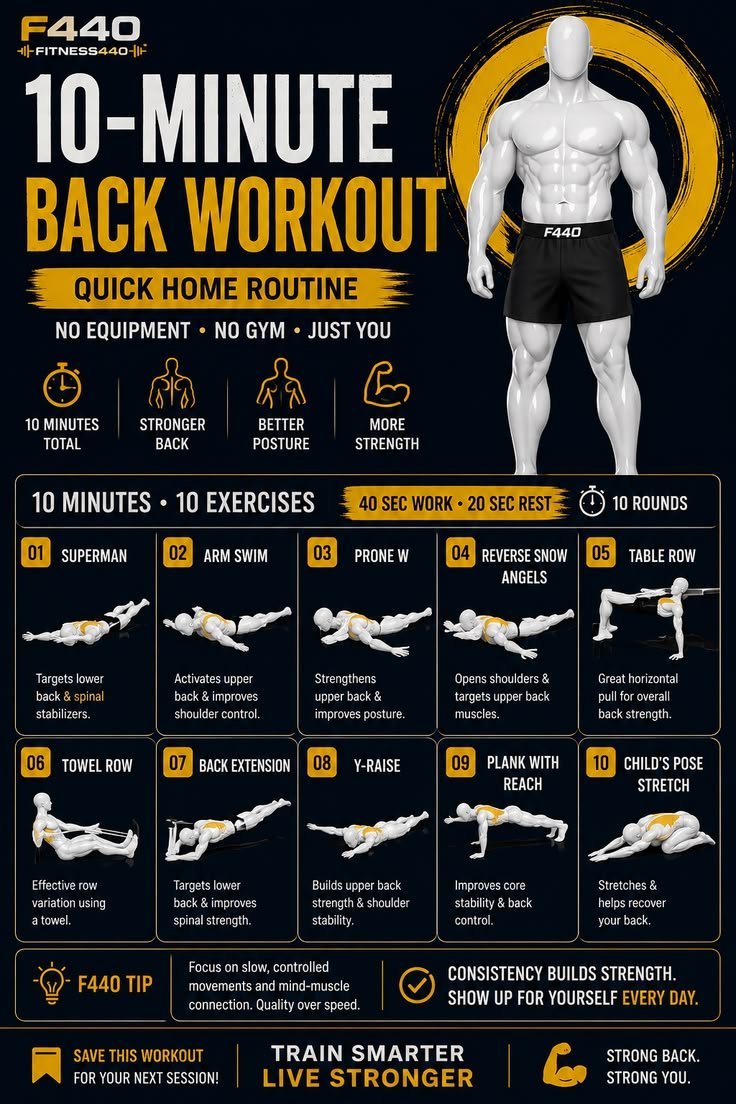
The back plays an important role in everyday movement. It helps support the body, maintain posture, and work with the shoulders, arms, hips, and core during many activities. Building basic back strength can make it easier to perform everyday movements with good control.
You do not need a gym or expensive equipment to begin training your back. Several simple exercises can be performed at home using bodyweight and controlled movements. For beginners, the main goal should be learning proper movement, improving strength gradually, and building consistency.
Back exercises can involve different areas of the upper, middle, and lower back. Many movements also involve the core and hips, which makes them useful for general physical fitness.
1. Bird Dog
The bird dog is a beginner-friendly exercise that focuses on stability and controlled movement.
Start on your hands and knees with your hands underneath your shoulders and your knees underneath your hips. Keep your back in a comfortable neutral position.
Slowly extend one arm forward while extending the opposite leg backward. Try to keep your hips and shoulders stable.
Hold the position briefly, then return your hand and foot to the floor. Repeat on the opposite side.
You do not need to lift your arm or leg extremely high. Controlled movement is more important than reaching as far as possible.
2. Superman Exercise
The Superman exercise is a bodyweight movement that works the muscles along the back while also involving the hips and shoulders.
Lie face down on a comfortable surface. Extend your arms in front of you and keep your legs extended behind you.
Gently lift your arms and legs a small distance from the floor while keeping your movement controlled. Hold briefly, then slowly lower them.
You do not need to lift very high. A small, controlled movement can be enough for beginners.
If the exercise causes discomfort in your lower back, reduce the range of motion or choose another exercise.
3. Prone Y Raise
A prone Y raise is a simple exercise for practicing upper-back and shoulder control.
Lie face down with your arms extended forward at an angle so that your body forms a shape similar to the letter Y.
Gently lift your arms from the floor while keeping your neck relaxed. Hold briefly and lower your arms slowly.
The movement should be small and controlled. There is no need to force your arms upward.
This exercise can be useful for beginners who want to improve upper-back movement without using weights.
4. Prone T Raise
The prone T raise is similar to the Y raise, but your arms move out to the sides.
Lie face down and extend your arms sideways, forming a T shape with your body.
Gently lift your arms and squeeze your shoulder blades together in a controlled way. Lower your arms slowly.
Avoid lifting your head at the same time. Keep your neck relaxed and focus on moving your arms and upper back.
5. Glute Bridge
Although the glute bridge is often considered a lower-body exercise, it also helps develop control through the hips and lower back.
Lie on your back with your knees bent and your feet flat on the floor.
Place your arms comfortably beside your body. Tighten your core gently and press through your feet to lift your hips.
Pause briefly at the top and then lower your hips slowly.
Try to avoid pushing your hips excessively high. The movement should feel controlled and comfortable.
Strong hip movement can support many activities that involve the back and lower body.
6. Bird Dog Hold
Once you are comfortable with the basic bird dog, you can practice holding the extended position.
Start on your hands and knees. Extend one arm and the opposite leg.
Hold the position for a short period while keeping your body stable. Then return to the starting position and switch sides.
If you notice your hips rotating or your lower back moving excessively, reduce the length of the hold.
This exercise is more about stability and control than speed.
7. Wall Angels
Wall angels can help beginners practice upper-back and shoulder movement.
Stand with your back near a wall. Place your arms in a comfortable position with your elbows bent.
Slowly move your arms upward and then back down.
Do not force your arms to remain against the wall if your mobility does not allow it. Keep the movement comfortable and controlled.
Wall angels can be included in a warm-up or a beginner upper-body routine.
8. Reverse Snow Angels
Reverse snow angels are performed while lying face down and can help develop control in the upper back and shoulders.
Lie on your stomach with your arms extended near the floor.
Slowly move your arms outward and toward your sides, similar to making a snow angel. Then return them to the starting position.
Keep the movement slow and avoid lifting your chest excessively.
If you feel uncomfortable, reduce the range of motion.
9. Cat-Cow Movement
The cat-cow movement is commonly used to practice gentle spinal movement.
Start on your hands and knees.
Slowly round your back upward while allowing your head and neck to move naturally. Then gently move in the opposite direction, bringing your chest forward while allowing your back to extend comfortably.
Do not force either position.
Move slowly and breathe naturally throughout the exercise.
This movement can be useful as part of a warm-up before other exercises.
10. Plank
The plank is mainly known as a core exercise, but your back and shoulders also work to stabilize your body.
Start with your hands on the floor and your arms extended, or use your forearms if that feels more comfortable.
Keep your body aligned and your core gently engaged.
Hold the position for a manageable amount of time. You do not need to hold the plank for several minutes.
If your hips begin to drop or rise significantly, stop and rest.
Beginners can also perform a modified plank with their knees on the floor.
11. Side Plank
The side plank challenges the muscles responsible for stabilizing your trunk.
Lie on your side and support yourself with your forearm. Lift your hips while keeping your body aligned.
You can keep your knees bent to make the exercise easier.
Hold the position for a short period and then switch sides.
The side plank can help develop stability around the trunk, which is useful when performing many other movements.
12. Hip Hinge Practice
Learning the hip hinge is an important skill for beginners because it teaches you how to move through your hips while keeping control of your back.
Stand with your feet around hip width apart. Place your hands on your hips.
Push your hips backward while keeping your spine in a comfortable neutral position. Slightly bend your knees as you move.
Then push through your feet and bring your hips forward to return to standing.
Move slowly at first.
You can practice this movement against a wall by standing a short distance in front of it and trying to move your hips backward toward the wall.
Why Back Strength Matters
Your back works during many everyday activities. You use it when sitting, standing, walking, reaching, carrying objects, and changing positions.
Developing basic back strength can support better movement control and help you perform different exercises more comfortably.
However, back training does not mean performing difficult exercises every day. Beginners can make progress through simple movements performed consistently.
How to Build a Beginner Back Workout
A simple routine could include several exercises that target stability, movement, and strength.
For example:
- Bird dog
- Glute bridge
- Prone Y raise
- Plank
- Hip hinge practice
You can perform each exercise for a manageable number of repetitions or a short hold.
The exact amount should depend on your current fitness level. Start comfortably and increase gradually rather than trying to do too much during your first few workouts.
Focus on Controlled Movements
One of the most important things for beginners is learning to control each exercise.
Avoid swinging your arms or moving quickly simply to complete more repetitions.
For exercises such as bird dogs and prone raises, slow movements can make it easier to notice whether your body is staying stable.
If your form becomes difficult to maintain, take a break.
Quality movement is more important than simply completing a large number of repetitions.
Warm Up Before Back Exercises
A short warm-up can prepare your body for exercise.
You can start with light walking or another easy movement. Then perform gentle movements such as cat-cow, arm circles, and hip hinges.
The warm-up should prepare you without making you tired.
If you experience discomfort during a warm-up movement, stop and choose a gentler alternative.
Progressing Without Equipment
You can make progress without using weights.
For example, you can begin with a basic bird dog and later practice holding each position longer.
You can also improve the quality of your movements and gradually increase your range of motion when comfortable.
Another option is moving from easier variations to more challenging versions.
For example, you might begin with a modified plank before progressing to a standard plank.
Progress should be gradual and appropriate for your current ability.
Common Mistakes Beginners Should Avoid
One common mistake is rushing through exercises. Fast movements can make it difficult to maintain control.
Another mistake is trying advanced exercises before learning the basic movement patterns.
Some beginners also try to train the same muscles every day. Your body needs recovery, so allow enough time between challenging sessions.
Ignoring pain is another problem. Exercise can feel challenging, but sharp or unusual pain should not be treated as something you simply need to push through.
If an exercise causes pain, stop and reassess the movement.
Combine Back Exercises With Other Training
A balanced workout should involve more than just the back.
You can combine back exercises with lower-body movements, chest exercises, shoulder exercises, core exercises, and light cardiovascular activities.
For example, a simple home session might include a squat, incline push-up, bird dog, glute bridge, and plank.
This approach allows you to train different movement patterns while keeping your routine simple.
Give Your Body Time to Recover
Rest is an important part of exercise.
Your muscles need time to recover after challenging workouts. Instead of trying to train your back intensely every day, include recovery days or alternate different types of exercise.
Light activities such as walking can be useful on easier days.
Sleep, regular meals, hydration, and appropriate rest can also support your general ability to exercise.
Pay Attention to Your Technique
Good technique becomes especially important when working with the back.
Keep movements controlled and avoid forcing your spine into extreme positions.
For exercises involving the floor, use a comfortable surface that allows you to move without unnecessary pressure.
If you are unsure how to perform an exercise, ask a qualified coach, physical education teacher, or another knowledgeable adult to help you check your technique.
If you have a current injury or persistent pain, speak with a healthcare professional before beginning exercises that could affect the area.
Keep the Routine Simple
You do not need a large collection of exercises to begin strengthening your back.
A few basic movements performed consistently can give you an excellent starting point.
You can begin with bird dogs, glute bridges, planks, wall angels, and hip hinge practice. Once these movements become comfortable, you can gradually introduce more challenging variations.
The goal is to build good movement habits and improve your strength over time rather than trying to make every workout difficult.
Leave a Reply