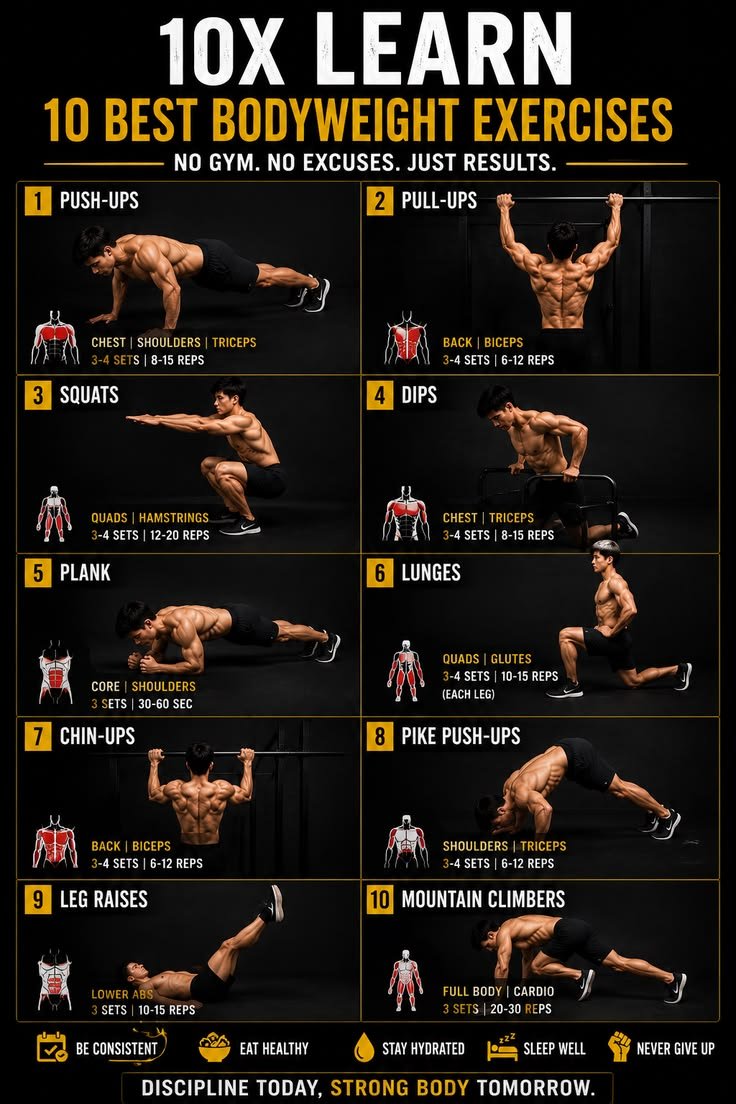
Bodyweight exercises are a convenient way to stay active without needing a gym or a large collection of exercise equipment. These exercises use your own body as resistance and can be adapted for different fitness levels. For beginners, bodyweight training can be a practical way to learn basic movement patterns and gradually develop strength, balance, coordination, and endurance.
One of the biggest advantages of bodyweight exercise is its simplicity. You can perform many exercises in a small space at home, and most of them require little preparation. Whether you are completely new to exercise or looking for simple movements to add to your routine, there are many options to choose from.
1. Bodyweight Squats
Bodyweight squats are one of the most useful exercises for a home workout. They primarily involve the lower body and can be adjusted according to your ability.
To perform a squat, stand with your feet in a comfortable position. Keep your upper body controlled and slowly bend your hips and knees to lower yourself. Go down only as far as you can comfortably control, then push through your feet to return to the standing position.
Try to avoid rushing through the movement. Performing each repetition with control can help you become more familiar with the exercise.
Beginners can start with a small number of repetitions and gradually increase them as the movement becomes easier.
2. Push-Ups
Push-ups are a classic bodyweight exercise that can be performed almost anywhere. They involve several muscles in the upper body and core.
Start in a position with your hands placed on a stable surface and your body controlled. Bend your elbows to lower yourself, then push away from the surface to return to the starting position.
Traditional floor push-ups may be difficult for some beginners. If necessary, start with wall push-ups or incline push-ups.
Wall push-ups involve standing and pushing against a wall, while incline push-ups can be performed with your hands on a stable elevated surface.
As your ability improves, you can gradually work toward more challenging versions.
3. Glute Bridges
Glute bridges are a simple floor exercise that focuses on the hips and lower body.
Lie on your back with your knees bent and your feet resting comfortably on the floor. Place your arms beside you and slowly raise your hips. Pause briefly at the top, then lower your hips in a controlled manner.
The movement should be smooth rather than fast.
Glute bridges can be included in beginner workouts because they do not require equipment and can be performed in a relatively small space.
4. Lunges
Lunges are another useful bodyweight exercise for the lower body.
Stand upright and take a controlled step forward or backward. Bend your knees and lower your body as far as comfortable, then return to the starting position.
For beginners, reverse lunges can sometimes feel easier to control because stepping backward can provide a more manageable movement pattern.
If balance is difficult, you can practice the movement near a stable surface for support.
Start slowly and focus on maintaining control throughout the exercise.
5. Planks
The plank is a bodyweight exercise that involves maintaining a stable position instead of repeatedly moving through repetitions.
Beginners can start with a modified plank from the knees if a full plank is too difficult.
Place your hands or forearms in a comfortable position and keep your body controlled. Avoid trying to hold the position for an unnecessarily long time.
A short, controlled hold can be more useful than a long hold performed with poor technique.
As you become more comfortable, you can gradually increase the duration.
6. Bird Dogs
Bird dogs are a useful exercise for practicing balance, coordination, and controlled movement.
Begin on your hands and knees. Slowly extend one arm and the opposite leg while keeping your body stable. Return them to the starting position and repeat on the other side.
Move slowly rather than trying to complete the exercise quickly.
If extending both an arm and a leg feels challenging, you can practice lifting one limb at a time until you become more comfortable.
7. Wall Sits
Wall sits are a simple way to add an isometric exercise to your home routine.
Stand with your back against a sturdy wall. Slowly bend your knees and slide down the wall until you reach a comfortable position. Hold the position briefly and then return to standing.
You do not need to hold the wall sit for a long period when you are starting.
As you become stronger and more comfortable, you can gradually increase the duration of the hold.
8. Step-Ups
Step-ups can be performed using a stable step that is suitable for exercise.
Place one foot on the step and carefully bring the other foot up. Step back down with control and repeat.
You can alternate legs during the exercise.
The surface must be stable and secure. Never use an object that can easily move, tip, or collapse.
For beginners, a lower step may be more appropriate than a high surface. The purpose is to practice controlled movement rather than making the exercise unnecessarily difficult.
9. Standing Knee Raises
Standing knee raises are easy to include in a home workout and require very little space.
Stand upright and slowly lift one knee toward your comfortable range of motion. Lower it and repeat with the other leg.
You can perform the exercise slowly to focus on balance or use a slightly faster pace as part of a general movement routine.
If balance is difficult, perform the exercise near a stable support.
10. Mountain Climbers
Mountain climbers are a more active bodyweight exercise that can increase the intensity of a workout.
Start in a controlled position with your hands on the floor. Bring one knee forward and then return it while bringing the opposite knee forward.
Beginners should focus on learning the movement before trying to perform it quickly.
If the traditional version feels too difficult, you can slow down the movement and take more time between repetitions.
The exercise should be performed only at an intensity that is appropriate for your current fitness level.
11. Calf Raises
Calf raises are a simple exercise that can be performed while standing.
Stand upright with your feet comfortably positioned. Slowly raise your heels so that you are standing higher on the balls of your feet. Pause briefly and lower your heels.
You can use a stable surface for balance if necessary.
Because the movement is simple, calf raises can easily be added to a short home workout or performed as part of a larger lower-body routine.
12. Superman Exercise
The Superman exercise is performed on the floor and involves controlled movement of the arms and legs.
Lie face down with your arms extended in front of you. Slowly lift your arms and legs only as far as you can comfortably control, then lower them.
Do not force the movement or try to lift your limbs extremely high.
The goal is controlled movement rather than creating a large range of motion.
13. Dead Bug
The dead bug is another floor-based bodyweight exercise that emphasizes controlled movement.
Lie on your back with your arms raised and your knees bent. Slowly move one arm and the opposite leg away from the starting position, then return them.
Repeat on the opposite side.
Beginners can make the exercise easier by moving only one limb at a time.
Keeping the movement slow can help you concentrate on maintaining control.
14. Side Leg Raises
Side leg raises can be performed while lying on your side.
Keep your body in a comfortable position and slowly raise the upper leg before lowering it again.
Avoid swinging the leg quickly.
The movement can be performed for several controlled repetitions before changing sides.
This exercise requires very little space and can be useful when creating a simple lower-body routine.
15. Chair-Assisted Squats
Chair-assisted squats can help beginners become familiar with the squat movement.
Stand in front of a stable chair and slowly lower yourself toward it. Lightly touch the chair if appropriate and then return to standing.
The chair should be stable and should not slide easily.
This variation can provide a reference point for beginners who are still learning how to control the squat movement.
How to Build a Bodyweight Workout
You do not need to perform every bodyweight exercise in one session.
A simple workout could include exercises from different areas of the body.
For example:
- Bodyweight squats
- Incline push-ups
- Glute bridges
- Bird dogs
- Calf raises
- A short plank
You can perform a manageable number of repetitions for each exercise and take breaks between movements.
As you become more comfortable, you can gradually increase the amount of work.
How Beginners Can Progress
Progressing with bodyweight exercises does not always mean doing hundreds of repetitions.
There are several ways to make an exercise more challenging.
You could increase the number of repetitions, add another set, increase the duration of an exercise, reduce unnecessary rest, or move to a more challenging variation.
For example, someone might begin with wall push-ups, progress to incline push-ups, and eventually work toward regular push-ups.
The same principle can be applied to many other bodyweight movements.
Focus on Good Technique
Technique is an important part of bodyweight training.
If you are rushing through an exercise, losing balance, or struggling to maintain the intended position, it may be better to stop and rest.
You do not need to perform an exercise as quickly as possible.
Controlled movements can help beginners learn how their body should move.
It is also useful to understand that exercises may look slightly different from person to person because people have different levels of mobility, strength, coordination, and experience.
Create a Consistent Routine
A bodyweight workout can be useful when it becomes part of a regular routine.
Choose exercise days that fit your schedule. You might start with several sessions throughout the week and allow recovery time between more demanding workouts.
Your routine does not need to be complicated.
A simple plan that you can follow consistently may be easier to maintain than an advanced workout program that is difficult to fit into your daily life.
Make Your Home Workouts More Interesting
Doing the same exercises repeatedly can sometimes become boring.
You can keep your routine interesting by changing the order of exercises, trying different beginner-friendly variations, or combining strength movements with
Leave a Reply