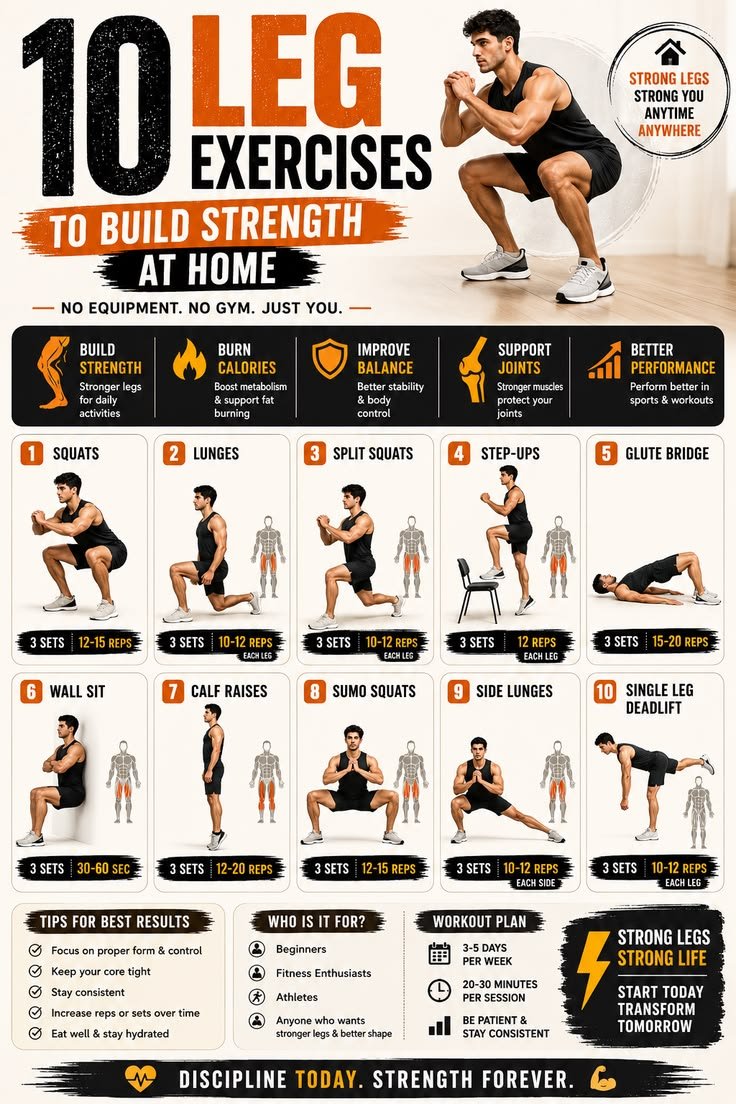
Strong legs are important for many everyday activities, including walking, climbing stairs, standing, running, and maintaining balance. You do not need a gym or expensive equipment to begin working on your leg strength. Many simple exercises can be performed at home using your body weight.
For beginners, the best approach is to start with basic movements, learn how to perform them with control, and gradually increase the challenge. A simple home routine can include exercises that involve the thighs, hips, calves, and other muscles involved in lower-body movement.
Why Leg Exercises Are Important
The legs are involved in almost every type of movement you perform during the day. Walking to another room, standing from a chair, climbing stairs, and carrying everyday items all require your lower body to work.
Regular leg exercises can help you practice strength, balance, coordination, and movement control.
You do not need to perform complicated exercises to get started. Basic movements such as squats, lunges, glute bridges, and calf raises can provide a useful foundation for beginners.
1. Bodyweight Squats
Bodyweight squats are one of the most common lower-body exercises and are easy to perform at home.
Stand with your feet in a comfortable position. Keep your upper body controlled and slowly bend your hips and knees to lower your body. Move down only as far as you can comfortably control, then push through your feet to return to standing.
Try not to rush.
The downward and upward portions should both be controlled.
If you are new to squats, you can practice using a stable chair as a reference point. You do not need to go very low to begin learning the movement.
As you become more comfortable, you can gradually increase the number of repetitions.
2. Reverse Lunges
Reverse lunges are another useful bodyweight exercise for the legs.
Start by standing upright. Step one foot backward and bend your knees in a controlled manner. Lower yourself only as far as comfortable, then push through the front foot to return to your starting position.
Repeat with the other leg.
If you have difficulty maintaining balance, you can perform the exercise near a stable surface that can provide support when necessary.
Start with a small number of repetitions and focus on keeping the movement controlled.
3. Glute Bridges
Although glute bridges are often associated with the hips, they also involve muscles throughout the lower body.
Lie on your back with your knees bent and your feet on the floor. Keep your arms beside you. Press your feet into the floor and slowly raise your hips.
Pause briefly at the top and then lower your hips.
Avoid using fast or jerky movements.
Glute bridges are particularly convenient for home workouts because they require very little space and no special equipment.
4. Calf Raises
Calf raises are a simple exercise that focuses on the lower part of the legs.
Stand upright with your feet comfortably positioned. Slowly raise your heels so that you are standing higher on the balls of your feet.
Pause briefly, then lower your heels back toward the floor.
If you need help with balance, you can stand near a stable surface and use it lightly for support.
As you become more comfortable, you can increase the number of controlled repetitions.
5. Wall Sits
Wall sits are an isometric exercise, meaning you hold a position rather than repeatedly moving through it.
Stand with your back against a sturdy wall. Slowly slide down until you reach a comfortable position.
Hold the position for a short period and then return to standing.
Beginners do not need to hold the position for a long time. Start with a short duration and gradually increase it if the exercise becomes easier.
If the position causes discomfort, return to standing and adjust your technique or choose another exercise.
6. Step-Ups
Step-ups can be performed using a stable step that is appropriate for exercise.
Place one foot on the step and carefully bring the other foot up. Step back down with control and repeat.
You can alternate legs during the exercise.
The height of the step should match your current ability.
Safety is especially important with step-ups. Do not use an unstable chair, box, or other object that could move or collapse.
The purpose of the exercise is to practice controlled lower-body movement, not to use the highest surface possible.
7. Side Leg Raises
Side leg raises are easy to perform at home and require very little space.
Lie on your side in a comfortable position. Keep your body controlled and slowly raise your upper leg before lowering it again.
Avoid swinging your leg.
Perform several controlled repetitions and then change sides.
This exercise can be included in a lower-body routine alongside squats, lunges, and glute bridges.
8. Standing Leg Extensions
Standing leg extensions can be performed while holding a stable surface for balance.
Stand upright and slowly move one leg backward without leaning excessively. Return the leg to its starting position and repeat.
Change sides after completing your repetitions.
The movement should remain controlled.
You do not need to move your leg very far. Focus on maintaining balance and controlling the movement.
9. Chair-Assisted Squats
Chair-assisted squats can be useful for beginners who are still learning how to squat.
Stand in front of a stable chair and slowly lower yourself toward it.
Once you reach a comfortable position, return to standing.
The chair should not move easily.
You can use the chair as a reference point rather than dropping heavily onto it.
As your confidence improves, you may be able to perform regular bodyweight squats without assistance.
10. Split Squats
Split squats use a staggered stance to place more emphasis on one leg at a time.
Stand with one foot slightly in front of the other. Slowly bend your knees and lower your body, then return to the starting position.
Beginners can keep the range of motion small while learning the movement.
Balance can be challenging at first, so practice near a stable support if necessary.
You do not need to perform many repetitions. Focus on maintaining control and keeping the movement comfortable.
11. Glute Bridge Marches
Once regular glute bridges become comfortable, you can explore a more challenging variation.
Start in the same position as a normal glute bridge and raise your hips. While keeping your hips controlled, slowly lift one foot slightly and then return it to the floor.
Repeat on the opposite side.
This movement requires more control than a basic glute bridge, so beginners should first become comfortable with the standard version.
12. Standing Calf Holds
Instead of repeatedly raising and lowering your heels, you can hold the raised position for a short period.
Stand near a stable support if needed. Raise your heels and hold the position briefly before lowering them.
This can provide a simple variation when you want to change your workout without adding equipment.
How to Build a Beginner Leg Workout
You do not need to perform every exercise in one session.
A simple beginner workout might include:
- Bodyweight squats
- Reverse lunges
- Glute bridges
- Calf raises
- Side leg raises
Perform a manageable number of repetitions for each movement and rest between exercises.
You can begin with one or two rounds of the routine.
As your ability improves, you can gradually add another round or increase the number of controlled repetitions.
How Often Should You Train Your Legs?
Leg exercises can be included in a regular weekly routine, but your body also needs time to recover.
Beginners can start with several exercise sessions throughout the week rather than performing demanding leg workouts every day.
You can use other days for lighter activities such as walking or gentle mobility work.
The appropriate schedule depends on your fitness level, the intensity of your workouts, and your overall activity.
Progress Gradually
When your leg exercises become easier, you can gradually increase the challenge.
There are several ways to do this.
You can add repetitions, increase the number of sets, increase the duration of an isometric exercise, or try a slightly more challenging variation.
For example, you might start with chair-assisted squats before progressing to regular squats.
You could also begin with basic glute bridges before trying a more challenging variation.
Avoid making large changes too quickly.
Focus on Balance and Control
Leg strength is not only about moving heavy loads.
Balance and coordination are also important parts of lower-body movement.
Exercises such as single-leg movements, controlled lunges, and standing leg raises can help you practice balance.
However, beginners should not rush into difficult balance exercises.
Start with simple movements and use a stable support when appropriate.
Combine Leg Exercises With Other Activities
Although your focus may be stronger legs, a balanced exercise routine can include other forms of movement.
You can combine leg exercises with upper-body movements such as push-ups and core exercises such as bird dogs or modified planks.
Walking is also a simple activity that can complement a home workout routine.
This approach allows you to work on different areas of fitness instead of focusing on one type of movement.
Pay Attention to Technique
Good technique is important when performing lower-body exercises.
For example, when performing squats or lunges, avoid rushing through the movement.
If your balance becomes unstable or you can no longer control the exercise, stop and rest.
You do not need to perform a large number of repetitions to make your workout useful.
Controlled movement is a better starting point for beginners.
Rest and Recovery
Rest is an important part of training.
Your muscles need time to recover after exercise, particularly when you are doing movements that are new to you.
If your legs feel tired after a workout, give yourself appropriate recovery time before performing another demanding lower-body session.
Gentle walking and normal daily movement can still be part of your routine if you feel comfortable.
Stay Consistent
Building stronger legs takes time.
You may not notice major changes immediately, but regular practice can help you become more familiar with the exercises.
Try to focus on creating a routine that you can maintain.
If you miss a workout, do not assume that your entire routine has failed. Simply return to your normal schedule when you can.
Consistency is easier when your workouts are realistic.
Safety During Leg Workouts
Before exercising, make sure you have enough space to move safely.
If you use a chair, step, or wall for an exercise, check that it is stable.
Wear suitable clothing and footwear for the activity.
Stop an exercise if you experience sharp or severe pain. If you have an injury, medical condition, or concern about whether a particular exercise is appropriate for you, consider speaking with a qualified healthcare professional.
You should not feel that you need to ignore pain to make progress.
Keep Improving Your Routine
As you gain experience, your leg workout can gradually become more varied.
You can learn new bodyweight movements, explore different variations, and adjust the number of repetitions or sets.
However, you do not need to make your routine complicated.
A small group of basic exercises can remain useful for a long time.
The key is to perform movements that match your current ability and increase the challenge gradually.
Make Exercise Part of Your Lifestyle
Leg exercises can become one part of a broader active lifestyle.
Walking, recreational activities, household tasks, and other forms of movement can all complement your structured workouts.
You do not have to spend every day performing formal exercises.
Instead, aim to include regular movement throughout your week.
With simple exercises such as squats, lunges, glute bridges, calf raises, step-ups, and wall sits, beginners can create an effective home routine for practicing lower-body strength and movement. Starting gradually, using good technique, allowing recovery, and increasing the difficulty over time can help make the routine sustainable.
Leave a Reply