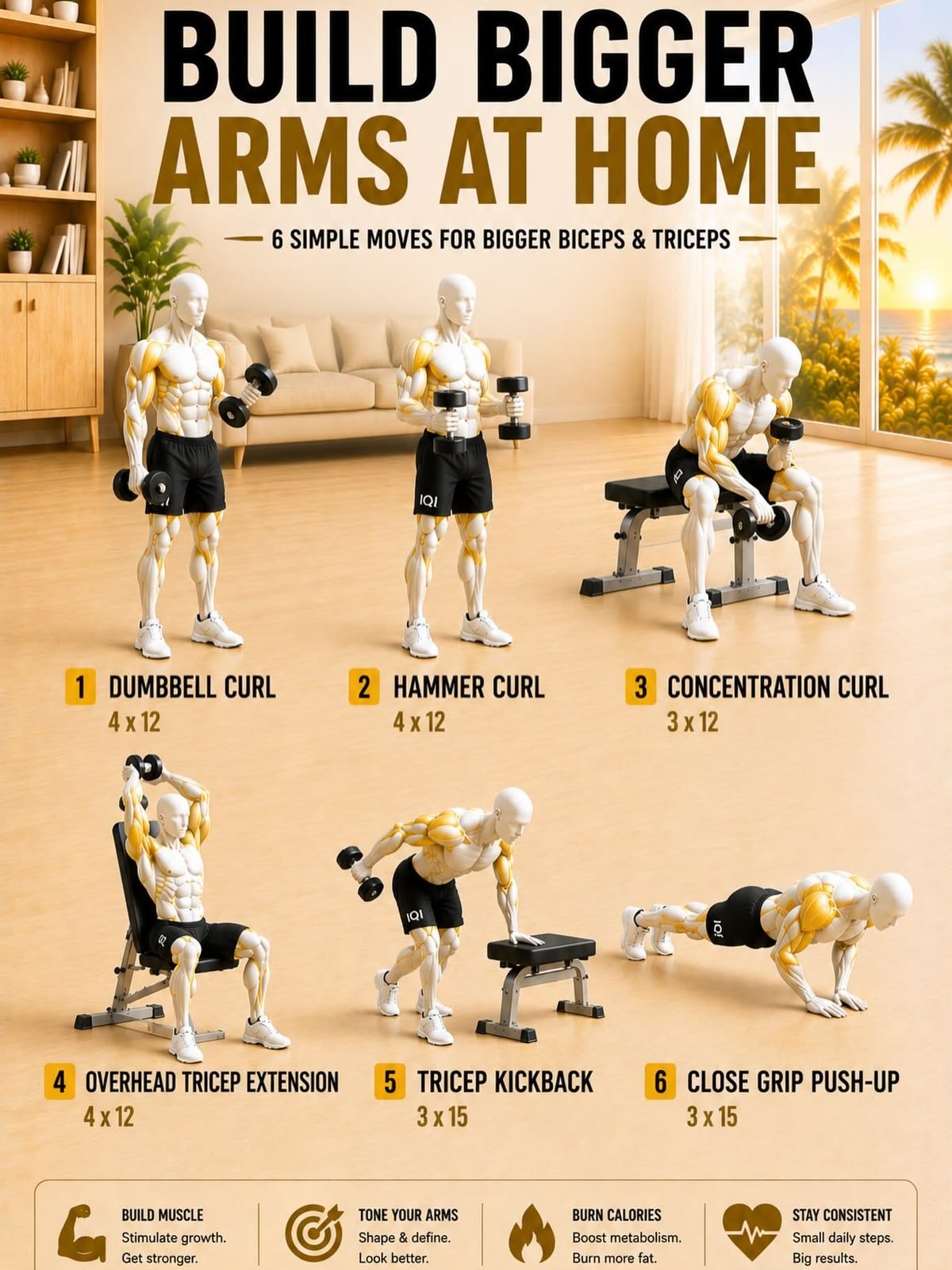
Strong arms can make everyday movements easier and can also support many different types of physical activity. You do not need a gym membership or expensive equipment to begin working on arm strength. Many simple exercises can be performed at home using your body weight and, when appropriate, basic household equipment.
For beginners, the most important thing is to start with exercises that match your current ability. Learning proper movement and gradually increasing the challenge can help you build a consistent exercise routine.
Arm training does not have to involve complicated exercises. Movements such as push-ups, wall push-ups, triceps dips, and certain bodyweight exercises can involve the muscles of the arms while also working other parts of the upper body.
Understanding Arm Strength
The arms are involved in many everyday movements, including pushing, pulling, lifting, carrying, and supporting the body.
Several muscles contribute to arm movement. The biceps are located on the front of the upper arm, while the triceps are located on the back. The shoulders, forearms, chest, and upper back also contribute to many exercises involving the arms.
Because these muscles often work together, a balanced arm workout does not necessarily need to isolate one muscle at a time.
For beginners, exercises that involve several muscles can be a practical way to develop general upper-body strength.
1. Wall Push-Ups
Wall push-ups are one of the simplest exercises for beginners.
Stand facing a wall and place your hands against it at a comfortable height. Keep your body controlled and slowly bend your elbows to bring your upper body toward the wall. Then push yourself away from the wall until your arms are extended again.
The movement should be slow and controlled.
Wall push-ups can be useful if regular floor push-ups are currently too difficult. As you become more comfortable, you can progress to incline push-ups using a stable elevated surface.
2. Incline Push-Ups
Incline push-ups provide a progression from wall push-ups toward traditional floor push-ups.
Place your hands on a stable elevated surface. Extend your legs behind you and maintain a controlled body position. Bend your elbows and lower your chest toward the surface, then push yourself back up.
The higher the stable surface, generally the easier the movement can be compared with a floor push-up.
Make sure the surface is secure before beginning. Do not use furniture that could move or collapse.
3. Regular Push-Ups
Traditional push-ups are a well-known bodyweight exercise that involves the arms, chest, shoulders, and core.
Start in a controlled position with your hands on the floor. Keep your body aligned and lower yourself by bending your elbows. Then push through your hands to return to the starting position.
If you cannot maintain control, use an easier variation instead.
You do not need to perform a large number of repetitions. A small number of controlled repetitions can provide a useful starting point.
4. Knee Push-Ups
Knee push-ups can be another option for beginners who are not yet comfortable with traditional push-ups.
Start with your hands on the floor and your knees supporting your lower body. Keep your upper body controlled as you bend your elbows and lower yourself. Then push back up.
The movement should remain controlled throughout.
As your strength improves, you may eventually feel comfortable trying incline or regular push-ups.
5. Triceps Dips
Triceps dips can involve the muscles at the back of the upper arm.
This exercise is sometimes performed using a stable bench or chair. However, safety is especially important. If you use a chair, make sure it is stable and cannot easily slide or tip.
Start with a small range of motion and avoid lowering yourself farther than you can comfortably control.
Beginners should not feel pressured to perform deep dips. A controlled movement is more important than trying to achieve a large range of motion.
6. Plank Shoulder Taps
Plank shoulder taps combine a plank position with controlled arm movement.
Start in a comfortable
Leave a Reply