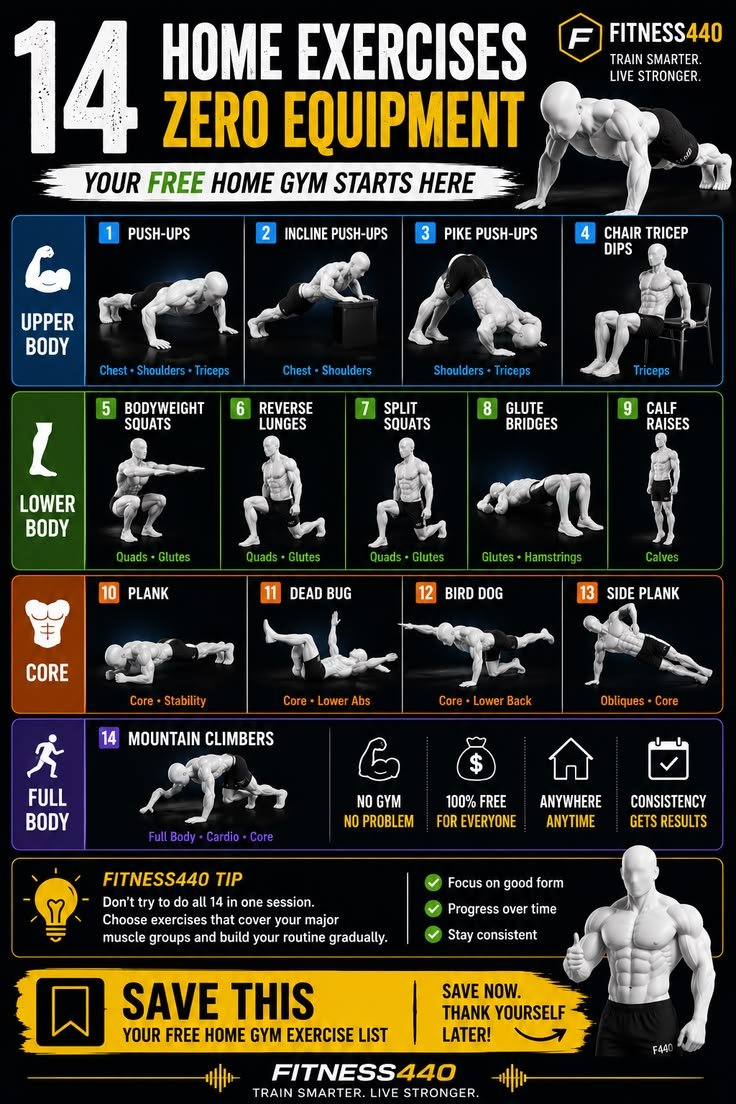
Improving physical strength does not always require a gym or expensive equipment. With a simple home exercise routine, you can gradually become stronger by using your own body weight and everyday movements. The most important things are consistency, good technique, enough recovery, and gradual progress.
Physical strength is useful for many daily activities. It can make it easier to carry objects, climb stairs, maintain good posture, and perform sports or recreational activities. Building strength can also help you develop better control over your movements and improve general fitness.
If you are exercising at home, you do not need to start with difficult exercises. Beginners can make progress by learning basic movements and slowly increasing the challenge as they become more comfortable.
Start With Basic Bodyweight Exercises
Bodyweight exercises are a convenient way to begin strength training at home. They use your body as resistance and can be adjusted for different fitness levels.
Some useful beginner exercises include:
- Squats
- Wall push-ups
- Incline push-ups
- Lunges
- Glute bridges
- Step-ups
- Calf raises
- Planks
- Bird dogs
- Wall sits
These movements train different areas of the body while also helping you learn basic exercise techniques.
For example, squats involve the legs and hips, while push-ups train the muscles used for pushing. Planks and bird dogs help develop core control. Using several different movements gives your workout more variety.
Learn Proper Technique First
One of the most important parts of becoming stronger is learning how to perform exercises correctly. Adding more repetitions is not useful if your technique becomes uncontrolled.
Take squats as an example. Stand with your feet in a comfortable position, keep your upper body controlled, bend your knees and hips, and lower yourself only as far as you can comfortably manage while maintaining good form. Then return to the starting position.
For push-ups, keep your body controlled as you lower and raise yourself. If a regular push-up is too difficult, begin with your hands against a wall or on a stable elevated surface.
Good technique allows you to practice the movement safely and consistently. It also makes it easier to measure your progress.
Use Easier Versions When Necessary
Strength training is not about immediately performing the hardest version of an exercise.
If you cannot perform a standard push-up comfortably, start with wall push-ups. Once those become easier, you can try incline push-ups. After developing more strength and control, you may gradually work toward floor push-ups.
The same idea can be applied to other movements.
For example:
Squat progression:
Chair squat → bodyweight squat → slower squat → more challenging squat variation
Push-up progression:
Wall push-up → incline push-up → knee push-up → standard push-up
The exact progression will depend on your current ability. There is no need to rush from one level to another.
Train Different Movement Patterns
A balanced home workout should include different types of movements rather than focusing on only one exercise.
You can include exercises that involve:
- Squatting
- Pushing
- Lunging
- Hip movement
- Core stabilization
- Stepping
- Calf movement
Squats and lunges challenge the lower body. Push-ups develop pushing strength. Glute bridges train the muscles around the hips. Planks and bird dogs develop control through the trunk.
Using different movements helps create a more complete routine.
Practice Squats
Squats are one of the simplest exercises for developing lower-body strength at home.
To perform a basic bodyweight squat, stand with your feet at a comfortable width. Keep your chest naturally upright and begin bending your hips and knees. Lower yourself in a controlled manner and then push through your feet to return to standing.
Start with a manageable number of repetitions. Focus on smooth movement rather than speed.
If regular squats feel difficult, you can practice sitting down and standing up from a sturdy chair. This provides an easy way to learn the movement.
Add Lunges
Lunges are another useful bodyweight exercise. They challenge the legs while also requiring balance and coordination.
Start from a standing position. Step one foot forward and lower your body in a controlled way. Then push through your feet to return to the starting position.
Beginners can hold onto a stable surface if they need additional balance.
You can also practice reverse lunges, where you step backward instead of forward. Choose the variation that allows you to maintain control.
Develop Pushing Strength
Push-ups are a popular home exercise because they require very little space or equipment.
However, standard push-ups can be challenging for beginners. Starting with an easier variation is completely acceptable.
Wall push-ups are one option. Stand facing a wall, place your hands against it, bend your elbows to move closer to the wall, and then push yourself away.
As you become more comfortable, you can move to an incline surface such as a sturdy table or bench designed to support your weight. Make sure the surface is stable before exercising.
Gradually progressing toward more difficult variations can help improve pushing strength without making the workout unnecessarily difficult.
Strengthen the Hips With Glute Bridges
Glute bridges are performed while lying on your back with your knees bent and feet placed on the floor.
Press your feet into the floor and gently lift your hips. Pause briefly at the top, then lower your hips in a controlled way.
This exercise works the muscles around the hips and also teaches you to control the movement of your pelvis.
You can include glute bridges as part of a lower-body or full-body home workout.
Build Core Strength
A strong core is useful for maintaining control during many different movements. You do not need complicated exercises to work your core.
Planks are a common option. Instead of trying to hold a plank for an extremely long time, focus on maintaining a controlled position for a manageable period.
Bird dogs are another beginner-friendly exercise. Start on your hands and knees, then slowly extend one arm and the opposite leg. Return them to the starting position and switch sides.
The goal is controlled movement rather than speed.
Use Step-Ups
If you have a safe, stable step that is specifically suitable for exercise, step-ups can be useful for developing lower-body strength and coordination.
Place one foot on the step and carefully step up. Bring the other foot up, then step down with control.
Use a low height when beginning. Make sure the surface is stable and there is enough space around you.
If you do not have a suitable step, there is no need to force the exercise into your routine. Squats, lunges, and other movements can provide alternatives.
Increase Difficulty Gradually
One of the main principles of strength training is progressive overload. In simple terms, your exercises need to become gradually more challenging over time.
You can increase difficulty in several ways.
For example, you might:
- Add a few repetitions
- Perform the movement more slowly
- Improve your range of motion
- Use a more challenging exercise variation
- Add another set when appropriate
- Reduce unnecessary rest slightly
You do not need to change everything at once.
If you perform ten controlled squats comfortably today, you might gradually work toward a slightly greater challenge over time. Small improvements can add up.
Do Not Exercise Hard Every Day
Recovery is an important part of getting stronger.
Your body needs time to recover after exercise. Training the same muscles intensely every day may leave you tired and can make it harder to maintain good technique.
A beginner can often start with a few strength sessions each week rather than trying to exercise intensely every day.
On other days, you can focus on normal daily activity, gentle movement, mobility, or rest.
The right schedule depends on your fitness level and how your body responds to training.
Warm Up Before Exercise
A short warm-up can prepare you for your workout.
You can begin with a few minutes of easy movement, such as walking around the room. Follow this with gentle dynamic movements that prepare the joints and muscles for the exercises you plan to perform.
For example, before a lower-body workout, you might practice controlled bodyweight squats and gentle leg movements.
A warm-up does not need to be exhausting. Its purpose is to prepare you for the session.
Pay Attention to Recovery
Exercise is only one part of improving physical strength. Recovery matters too.
Try to maintain a regular sleep schedule and give your body enough time to rest between challenging workouts. Eating regular, balanced meals also provides your body with energy and nutrients needed for normal activity and recovery.
You do not need complicated diets or special products to begin strength training. Focus on regular meals, a variety of nutritious foods, and enough fluids.
Create a Simple Weekly Routine
A simple routine can make it easier to stay consistent.
For example, a beginner might organize a week like this:
Day 1: Full-body strength workout
Day 2: Light activity or rest
Day 3: Full-body strength workout
Day 4: Light activity or rest
Day 5: Full-body strength workout
Day 6: Easy movement or recreational activity
Day 7: Rest
The exact schedule can be adjusted around school, work, family activities, and other responsibilities.
The goal is to create a routine that you can maintain rather than making your schedule unnecessarily difficult.
Keep Track of Your Progress
Tracking your workouts can help you notice improvements that might otherwise be easy to miss.
You could write down the exercises you performed, the number of repetitions, how many sets you completed, and which variation you used.
For example:
- Squat — 2 sets of 10
- Incline push-up — 2 sets of 8
- Glute bridge — 2 sets of 10
- Bird dog — 2 sets per side
- Plank — short controlled holds
After several weeks, you may notice that exercises feel easier or that you can perform a more challenging variation with better control.
Progress is not always about doing more repetitions. Better technique and improved control are also useful signs of progress.
Avoid Common Training Mistakes
Several mistakes can make home strength training less effective.
One common mistake is trying to progress too quickly. If an exercise is difficult, rushing into a harder version can make it harder to maintain proper technique.
Another mistake is doing only one type of exercise. A routine that includes different movements can provide more balanced training.
Some people also ignore recovery. Being consistent does not mean exercising as hard as possible every day.
Finally, avoid exercising through sharp or unusual pain. Stop the movement and, if pain continues or concerns you, speak with a parent, guardian, coach, teacher, or qualified healthcare professional.
Make Strength Training Enjoyable
The best home workout is one that you can perform consistently and safely.
You can keep your routine interesting by changing exercises occasionally, learning new movement variations, or combining strength exercises with activities you enjoy.
You can also exercise with a friend or family member if that makes the activity more enjoyable.
Strength development is a gradual process. You do not need to measure yourself against another person. Focus on learning movements, practicing consistently, and noticing your own progress over time.
With basic exercises, proper technique, gradual progression, and enough recovery, home strength training can become a useful part of a healthy and active lifestyle.
Leave a Reply