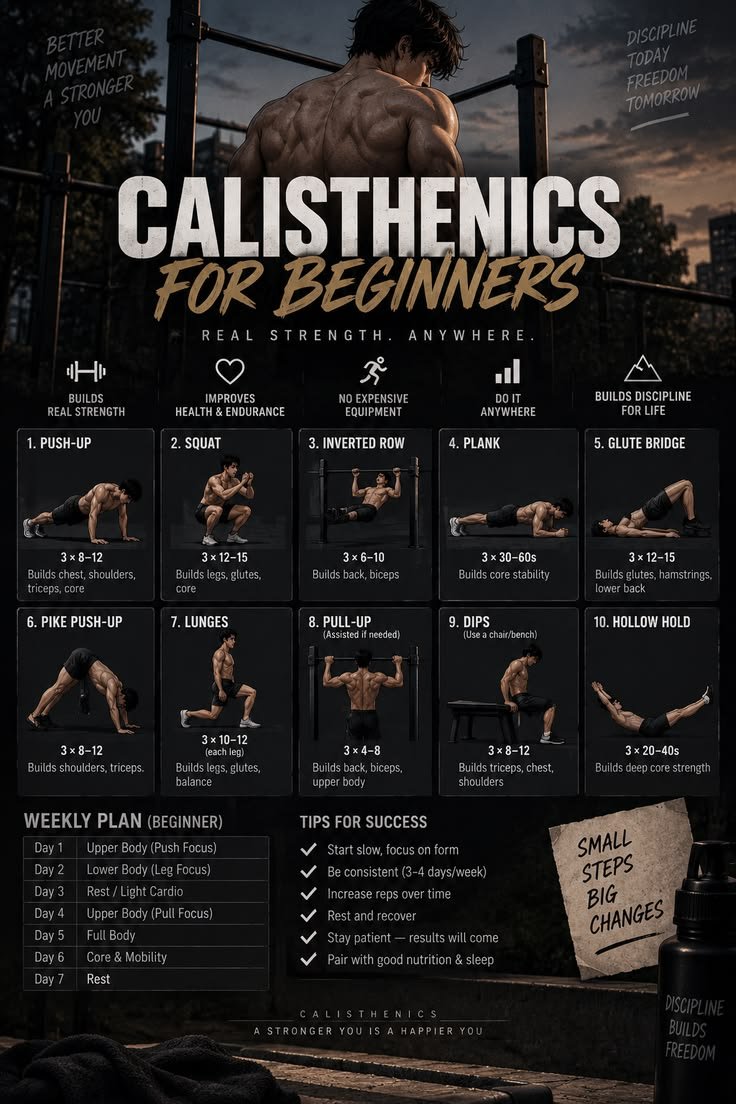
Calisthenics is a form of exercise that mainly uses your own body weight for resistance. It can be practiced at home, outdoors, or in a simple workout space without needing a large collection of equipment. For beginners, calisthenics can be a practical way to learn basic movement patterns while developing strength, balance, coordination, and body control.
You do not need to be advanced to start calisthenics. Many exercises have beginner-friendly versions that can be adjusted according to your current ability. Starting with simple movements allows you to learn proper technique before gradually moving toward more challenging exercises.
A good beginner routine does not need to contain complicated movements. Exercises such as squats, push-ups, lunges, planks, and glute bridges can provide a useful foundation.
What Is Calisthenics?
Calisthenics uses bodyweight movements to develop physical abilities. Instead of relying mainly on machines or heavy weights, you use your body as resistance.
Some calisthenics exercises are very simple, while others can become highly advanced. Beginners should focus on basic exercises before attempting difficult movements.
The main skills developed through beginner calisthenics include strength, balance, mobility, coordination, and control.
1. Bodyweight Squats
Bodyweight squats are one of the best starting exercises for beginners.
Stand with your feet around hip width apart. Keep your feet stable and your upper body comfortable.
Bend your knees and hips while lowering your body as if you were sitting down. Keep your movement controlled.
Once you reach a comfortable depth, push through your feet to return to standing.
Squats train the legs and hips while also requiring core stability.
If regular squats are difficult, you can practice chair squats by lowering yourself toward a stable chair.
2. Wall Push-Ups
Wall push-ups are an excellent starting point for learning the push-up movement.
Stand facing a wall and place your hands against it around chest height.
Step your feet slightly backward and keep your body aligned.
Bend your elbows to bring your chest toward the wall. Then push through your hands to return to the starting position.
Wall push-ups are generally easier than floor push-ups, making them useful for beginners.
As you become more comfortable, you can progress to incline push-ups.
3. Incline Push-Ups
Incline push-ups are performed with your hands on a stable elevated surface.
Keep your body straight and lower your chest toward the surface by bending your elbows.
Then push yourself back up.
The height of the surface affects the difficulty. A higher surface generally makes the exercise easier.
Make sure the surface is stable before starting.
4. Knee Push-Ups
Knee push-ups can help beginners practice the push-up movement while reducing the amount of bodyweight being moved.
Start on your hands and knees.
Position your hands comfortably and keep your body controlled from your head toward your knees.
Lower your chest toward the floor and push back up.
Focus on maintaining control rather than trying to complete a large number of repetitions.
5. Standard Push-Ups
Once you are comfortable with easier variations, you can practice standard push-ups.
Start in a high plank position with your hands around shoulder width apart.
Keep your body aligned while bending your elbows and lowering your chest toward the floor.
Then push through your hands to return to the starting position.
If your technique becomes difficult, return to an easier variation.
6. Reverse Lunges
Reverse lunges are a useful beginner lower-body exercise.
Start standing with your feet comfortably apart.
Step one foot backward and lower your body by bending both knees.
Push through the front foot to return to standing.
Then switch sides.
Reverse lunges can be easier for some beginners to control than forward lunges because the backward step allows you to establish your position before lowering.
Use a wall for balance if needed.
7. Glute Bridges
Glute bridges are performed on the floor and require no equipment.
Lie on your back with your knees bent and your feet flat on the floor.
Keep your arms beside your body.
Press through your feet and lift your hips from the floor.
Pause briefly at the top and lower your hips slowly.
The exercise involves the hips and also requires the core to help stabilize the movement.
8. Bird Dogs
Bird dogs are useful for developing balance and body control.
Start on your hands and knees.
Extend one arm forward while extending the opposite leg backward.
Try to keep your hips and shoulders stable.
Hold briefly, return to the starting position, and switch sides.
You do not need to extend your arm and leg extremely high.
A controlled movement is more important than reaching a large range.
9. Planks
Planks are a simple bodyweight exercise for core stability.
Start in a high plank position or use your forearms.
Keep your body aligned and engage your core gently.
Hold the position for a manageable amount of time.
Beginners can perform a modified plank with their knees on the floor.
There is no need to hold a plank for a very long period. Focus on maintaining good form.
10. Side Planks
Side planks challenge the muscles that help stabilize the sides of the body.
Lie on your side and support yourself with your forearm.
Keep your knees bent if you need an easier version.
Lift your hips and maintain a controlled position.
Hold briefly, lower yourself, and switch sides.
As your strength improves, you can gradually practice a version with your legs extended.
11. Calf Raises
Calf raises are a simple lower-leg exercise.
Stand with your feet comfortably apart.
Slowly raise your heels so that you are standing on the balls of your feet.
Pause briefly and lower your heels.
Use a wall or another stable surface for balance if needed.
You can perform calf raises slowly to improve control.
12. Step-Ups
Step-ups can be performed using a stable, low step or platform.
Place one foot on the surface and carefully step upward.
Bring the other foot up and then step down in a controlled way.
Alternate legs or complete several repetitions on one side before switching.
Make sure the surface is stable and not slippery.
Choose a height that you can use safely and comfortably.
13. Superman Exercise
The Superman exercise can be used to practice back and hip control.
Lie face down with your arms extended forward.
Gently lift your arms and legs a small distance from the floor.
Hold briefly and slowly lower them.
Do not force the movement or try to lift extremely high.
If you feel discomfort in your back, reduce the range or choose another exercise.
14. Mountain Climbers
Mountain climbers combine core stability with leg movement.
Start in a high plank position.
Bring one knee toward your chest and return it to the starting position.
Then switch legs.
Beginners should perform the movement slowly enough to maintain control.
You do not need to turn mountain climbers into a fast exercise. Controlled repetitions can help you learn the movement.
15. Bear Crawl
The bear crawl is a bodyweight movement that requires coordination between the arms, legs, and core.
Start on your hands and knees.
Lift your knees slightly from the floor while keeping your back controlled.
Move one hand and the opposite foot forward, then switch sides.
Start with small movements.
If the exercise feels too difficult, practice holding the bear position without moving.
16. Dead Bug
The dead bug is a beginner-friendly core exercise.
Lie on your back with your arms raised and your knees bent.
Slowly lower one arm and the opposite leg while keeping your trunk stable.
Return to the starting position and switch sides.
Move slowly and avoid allowing your lower back to move excessively.
If the full movement is difficult, reduce the range of motion.
How to Build a Beginner Calisthenics Routine
You do not need to perform all of these exercises in one workout.
Choose several movements that cover different areas of the body.
For example, a beginner routine could include:
- Bodyweight squats
- Incline push-ups
- Reverse lunges
- Glute bridges
- Bird dogs
- Planks
This routine covers the legs, upper body, hips, and core.
Start with a manageable amount of work and take breaks between exercises.
Focus on Movement Quality
Calisthenics is about controlling your body.
Beginners sometimes focus too much on completing as many repetitions as possible. Instead, concentrate on performing each repetition with good technique.
For example, during a squat, keep your feet stable and control the lowering phase.
During a push-up, keep your body aligned and avoid rushing.
During a plank, stop when you can no longer maintain a stable position.
Good technique gives you a stronger foundation for future progress.
How to Progress in Calisthenics
Progression does not always mean performing more repetitions.
You can progress by moving from an easier variation to a more challenging one.
For example:
Wall push-up → incline push-up → knee push-up → standard push-up.
For squats, you might begin with chair squats before progressing to regular bodyweight squats.
For planks, you can begin with a modified version and gradually move toward a standard plank.
You can also improve your control, range of motion, or exercise consistency.
Warm Up Before Training
A short warm-up can prepare your body for calisthenics.
Start with light movement such as walking.
You can then perform gentle arm circles, hip movements, ankle movements, and a few easy repetitions of the first exercise.
A warm-up should prepare you without making you tired.
If a movement causes discomfort during your warm-up, choose an easier alternative.
Allow Time for Recovery
Your body needs recovery after exercise.
You do not need to perform difficult calisthenics workouts every day.
You can alternate training days with lighter activities such as walking or gentle mobility exercises.
Rest also gives you time to improve your movement quality before your next challenging workout.
Common Beginner Mistakes
One common mistake is attempting advanced calisthenics movements too early.
Exercises such as handstands, difficult muscle-up progressions, and other advanced skills require preparation and should not be rushed.
Another mistake is comparing your progress with other people.
Everyone begins with different levels of strength, coordination, and experience.
Focus on improving your own technique and learning exercises gradually.
Another mistake is ignoring recovery. Training harder does not automatically mean making better progress.
Make Calisthenics Part of Your Routine
One advantage of calisthenics is that many exercises can be performed with very little equipment.
You can practice basic movements at home or in an appropriate outdoor space.
The important thing is to create a routine that is realistic for your schedule.
You might perform a short full-body workout several times during the week rather than trying to complete a very long session.
Consistency makes it easier to develop exercise habits.
Safety During Beginner Calisthenics
Use a clear and stable area for your workouts.
If an exercise requires a surface such as a chair, step, or elevated platform, make sure it is stable before using it.
Do not force a movement beyond your current ability.
If you experience sharp or unusual pain, stop the exercise.
If you have an existing injury or health concern, consider getting advice from a healthcare professional before starting a new exercise routine.
Calisthenics should be a gradual process. Start with movements you can control, practice them regularly, and increase difficulty only when you are ready.
Leave a Reply