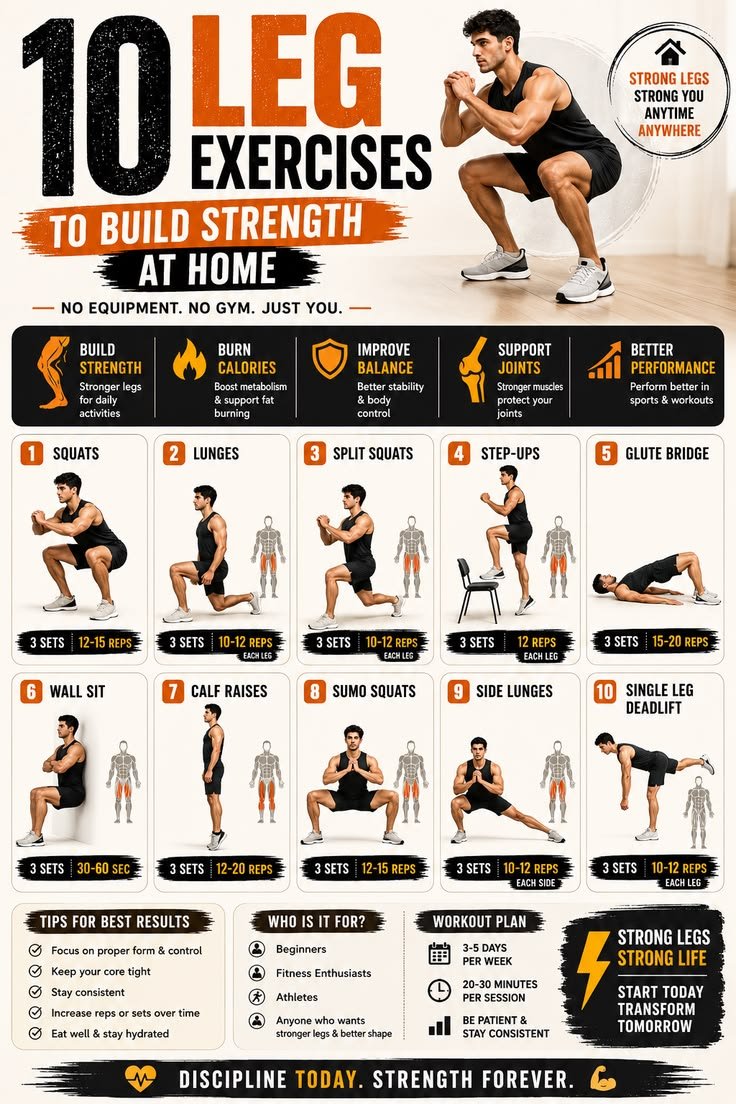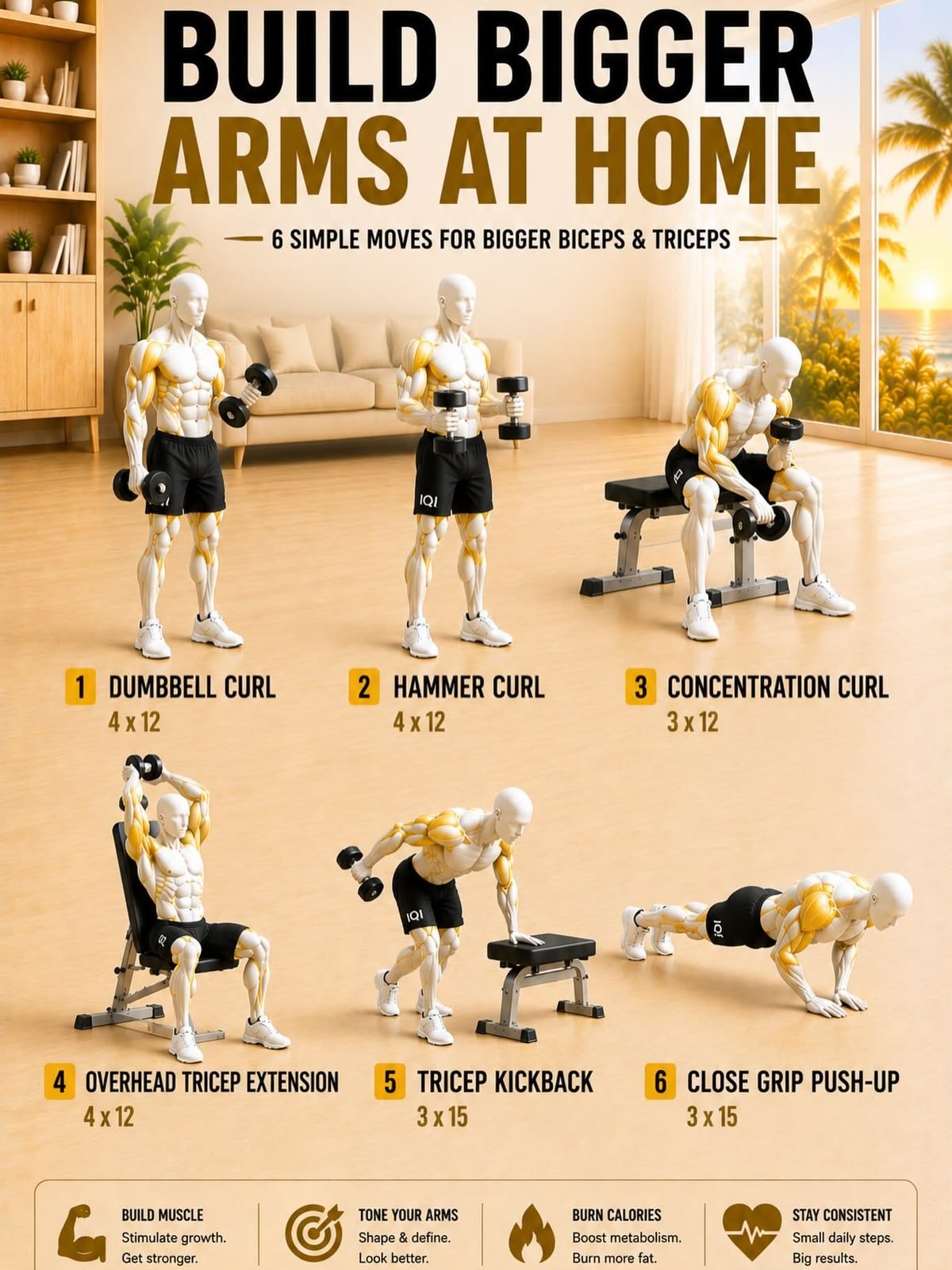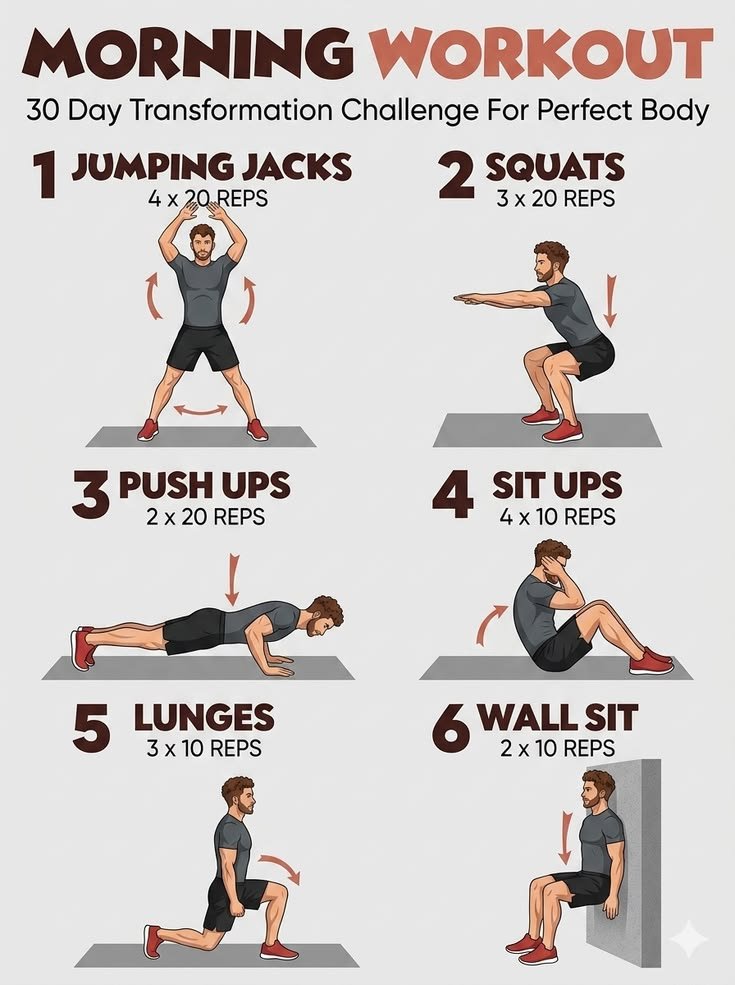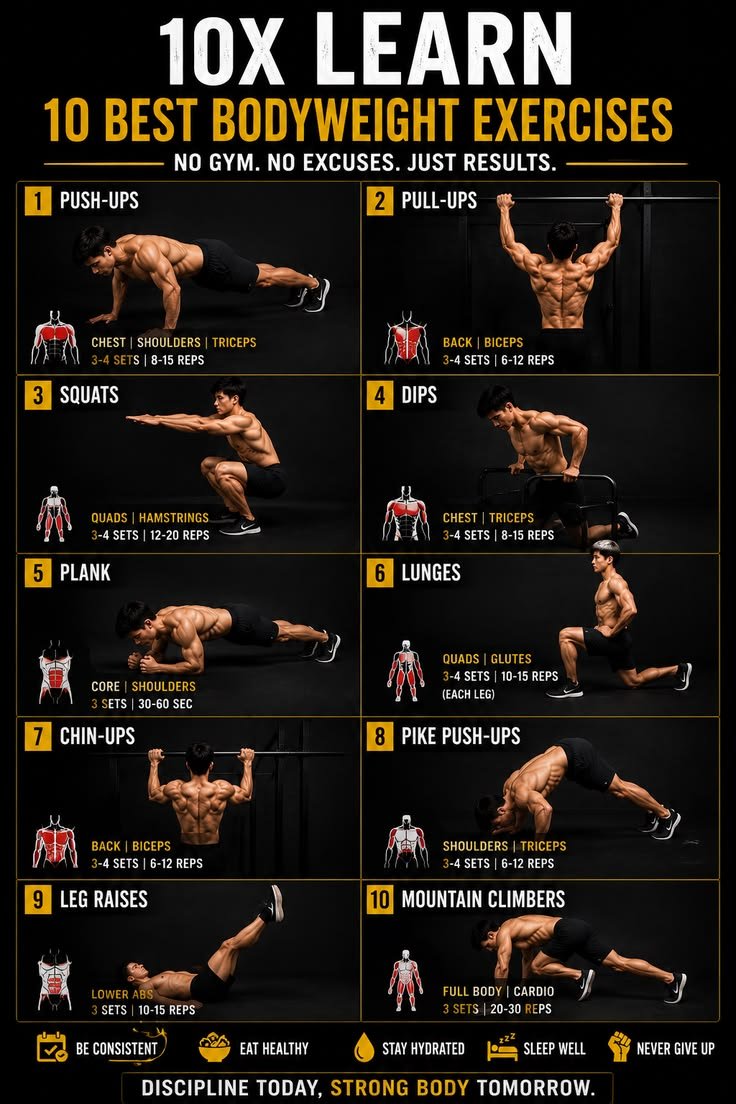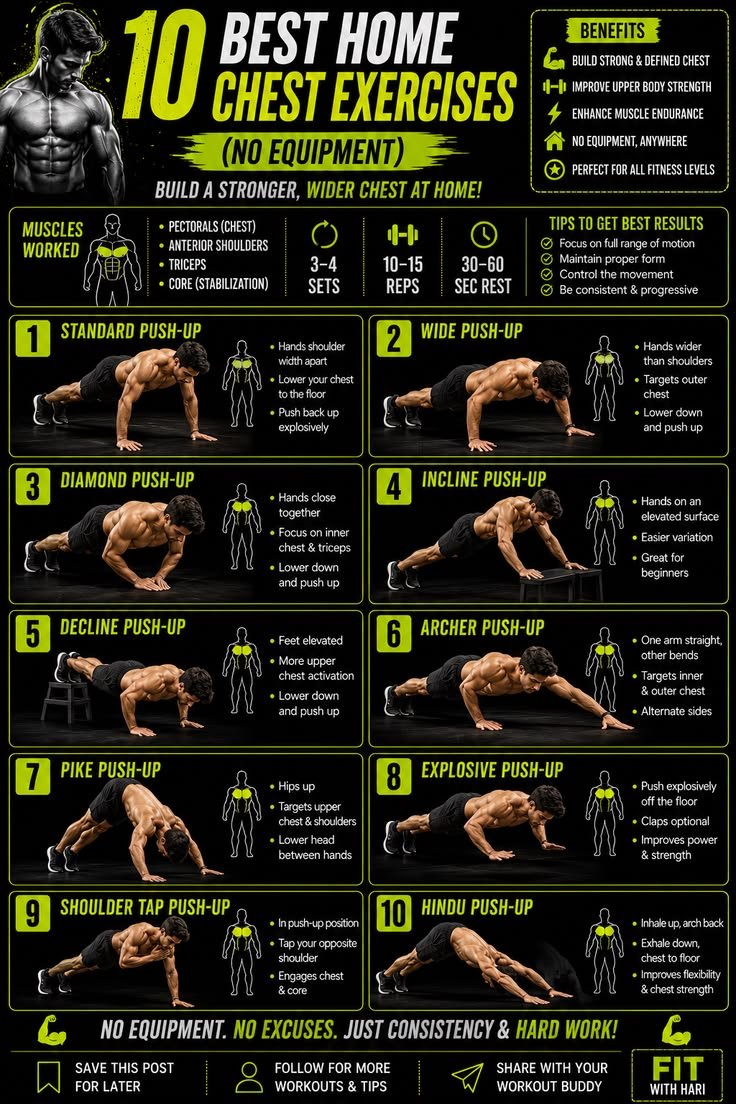
You do not need a gym membership or expensive equipment to train your chest. Bodyweight exercises can help improve upper-body strength, movement control, and overall fitness when they are performed with good technique and progressed gradually.
Chest exercises often work more than just the chest. Many movements also involve the shoulders, arms, and core, making them useful for developing general upper-body strength. The key is to choose exercises that match your current ability and increase the difficulty slowly as you become more comfortable.
1. Wall Push-Ups
Wall push-ups are one of the easiest ways to begin training the chest. They are especially useful for beginners who are not yet comfortable performing push-ups on the floor.
Stand facing a wall with your feet a comfortable distance away. Place your hands on the wall around chest height and slightly wider than your shoulders. Keep your body in a straight line from your head to your feet.
Bend your elbows slowly and bring your chest closer to the wall. Then push through your hands to return to the starting position.
Try to keep your movements controlled rather than rushing through each repetition. Wall push-ups can also help you learn the basic movement pattern used in more difficult push-up variations.
2. Incline Push-Ups
Incline push-ups are another beginner-friendly option. Instead of placing your hands on the floor, you place them on a stable elevated surface.
The higher the surface, the easier the movement generally becomes. As your strength improves, you can gradually use a lower surface.
Keep your hands around shoulder width or slightly wider. Maintain a straight body position while lowering your chest toward the surface. Push yourself back up while keeping your movements controlled.
Make sure the surface is stable before starting. Avoid using objects that can slide, tip, or move during exercise.
3. Knee Push-Ups
Knee push-ups reduce the amount of bodyweight you need to move compared with a standard push-up.
Start on your hands and knees. Move your hands slightly wider than shoulder width and extend your body from your knees toward your head. Keep your hips controlled instead of allowing them to drop toward the floor.
Bend your elbows and lower your chest toward the floor. Push through your hands to return to the starting position.
Knee push-ups can be useful while learning the technique needed for a full push-up. Focus on smooth repetitions rather than trying to perform as many as possible.
4. Standard Push-Ups
The standard push-up is one of the most practical bodyweight exercises for the chest and upper body.
Begin in a plank position with your hands placed approximately shoulder width apart. Keep your body aligned and your abdominal muscles engaged.
Bend your elbows and lower your body toward the floor. Stop at a comfortable depth where you can maintain good control. Then push through your hands to return to the starting position.
Your elbows do not need to be pushed extremely far away from your body. A comfortable position that allows your shoulders to move naturally is usually easier to control.
If standard push-ups are difficult, return to incline or knee push-ups and gradually build strength.
5. Slow Push-Ups
You can make a basic push-up more challenging without adding equipment by slowing down the movement.
Instead of quickly lowering and raising your body, take several seconds to lower yourself. Pause briefly if you can maintain good form, then push back up under control.
The slower movement requires greater control and can make a normal exercise feel more challenging.
However, there is no need to make every workout extremely difficult. Use slow repetitions occasionally and focus on maintaining proper technique throughout the movement.
6. Paused Push-Ups
Paused push-ups involve briefly stopping during the movement.
Start in your normal push-up position. Lower yourself under control and pause for a short moment near the bottom of the movement. Then push yourself back to the starting position.
The pause removes some of the momentum from the exercise. This means you need to control your body instead of relying on quick movements.
If holding the bottom position is uncomfortable, you can use a shorter pause or perform the exercise from an incline.
7. Wide-Hand Push-Ups
Wide-hand push-ups change the position of your hands compared with a standard push-up.
Place your hands somewhat wider than your usual position while keeping your body controlled. Lower yourself slowly and push back up.
You do not need to place your hands extremely far apart. A small change in hand position is enough to make the movement feel different.
Pay attention to your shoulders. If a particular hand position causes discomfort, return to a more comfortable position or choose another push-up variation.
8. Close-Hand Push-Ups
Close-hand push-ups place your hands closer together and generally increase the involvement of the arms.
Because the position can make the exercise more difficult, beginners may want to start with their hands only slightly closer than their normal push-up position.
Keep your elbows controlled as you lower your body. Your hands do not need to touch each other.
If you cannot maintain good form, switch to an easier variation.
9. Push-Up With a Short Pause at the Top
A controlled pause at the top can help you practice stability.
Begin in your push-up position and perform one repetition. When your arms are extended, hold the top position briefly while keeping your body aligned.
Then continue with the next repetition.
This variation is not necessarily about making the exercise much harder. Instead, it encourages you to control the movement from beginning to end.
10. Push-Up From the Knees With Slow Lowering
If regular knee push-ups feel manageable, you can add a slower lowering phase.
Start in your knee push-up position. Lower your chest slowly toward the floor, taking a few seconds to complete the movement. Then return to the starting position at a comfortable speed.
This can be a useful progression before attempting more challenging push-up variations.
The most important part is maintaining control. If your hips move excessively or your shoulders become uncomfortable, reduce the difficulty.
11. Incline Push-Up With a Slow Tempo
Incline push-ups can also be progressed by slowing down the movement.
Place your hands on a stable elevated surface. Lower your chest slowly while keeping your body aligned. Then push yourself back up.
This gives you an opportunity to practice controlled movement without needing to perform the exercise from the floor.
As you become stronger, you can gradually lower the height of the surface.
12. Push-Up Hold
An isometric push-up hold involves maintaining a position instead of performing repeated repetitions.
You can hold the top position of a push-up with your arms extended and your body aligned. Alternatively, if you have enough strength and can maintain comfortable shoulder positioning, you can briefly hold a lower position.
Do not force yourself to hold a difficult position for a long time. The goal is controlled strength, not exhaustion.
For beginners, holding the top plank-like position is generally a simpler option.
How to Build a Simple Chest Workout
You do not need to perform every exercise in one session. Choosing a few movements that match your ability is usually more practical.
For example, a beginner could start with:
- Wall push-ups
- Incline push-ups
- Knee push-ups
- Standard push-ups when ready
Another person who already has experience with push-ups might choose:
- Standard push-ups
- Slow push-ups
- Paused push-ups
- A different comfortable push-up variation
The exact number of exercises is less important than performing them with control and consistency.
Focus on Technique
Good technique should come before increasing difficulty.
During push-ups, try to keep your body reasonably straight. Avoid allowing your hips to drop significantly or rise excessively.
Keep your neck relaxed and look toward the floor rather than lifting your head repeatedly.
Your hands should be placed in a position that feels stable. Your elbows should move naturally rather than being forced into an extreme position.
If your technique breaks down because you are tired, stop the set or switch to an easier variation.
How Often Should You Train Your Chest?
Your chest does not need to be trained intensely every day.
Bodyweight exercises still place stress on muscles and joints, so recovery is an important part of exercise. Beginners can include chest-focused exercises as part of a balanced workout routine and allow adequate recovery between challenging sessions.
You can also combine chest exercises with movements for the legs, back, core, and general cardiovascular fitness.
A balanced routine is usually more useful than repeatedly training one area.
How to Progress Without Equipment
Progress does not always mean doing a huge number of repetitions.
You can progress by changing the exercise itself. For example, you might move from wall push-ups to incline push-ups, then knee push-ups, and eventually standard push-ups if they are appropriate for you.
You can also improve control by using a slower movement, adding a short pause, or improving your technique.
Another form of progress is simply becoming more comfortable with an exercise. If a movement that once felt difficult becomes easier while your technique remains controlled, that is useful progress.
Warm Up Before Chest Exercises
A short warm-up can prepare your body for exercise.
You can begin with several minutes of light movement, followed by gentle shoulder and arm movements. Arm circles, shoulder movements, and easy wall push-ups can help you gradually prepare for more demanding exercises.
There is no need to turn your warm-up into a difficult workout.
The purpose is to gradually increase movement and prepare your body for the exercises ahead.
Listen to Your Body
Exercise should challenge you, but sharp or unusual pain should not be ignored.
If an exercise causes pain in your shoulders, wrists, elbows, or another area, stop and reassess your technique. You can try an easier variation or take a break.
It is also normal for an exercise to feel difficult when you are learning it. Difficulty and pain are not the same thing.
Give yourself time to develop strength and coordination rather than trying to progress too quickly.
Combine Chest Exercises With Other Movements
Chest exercises are only one part of a complete fitness routine.
You can combine them with lower-body movements such as squats and lunges, core exercises such as planks, and other upper-body movements that train different muscles.
For example, a simple full-body session might include a push-up variation, a squat variation, a core exercise, and a light movement such as walking.
This approach helps you develop a broader range of physical abilities instead of focusing on one muscle group.
Keep Your Workouts Consistent
You do not need complicated equipment or an advanced program to begin improving your fitness.
Start with exercises that you can perform safely and comfortably. Practice them regularly and increase the difficulty gradually when you are ready.
A beginner who performs controlled wall or incline push-ups consistently can eventually develop the strength and technique needed for more challenging variations.
The goal is not to make every workout exhausting. Good movement, gradual progression, recovery, and consistency are more useful foundations for long-term exercise.
If you are new to exercise or have an existing injury or medical concern, getting guidance from a qualified adult, coach, or healthcare professional can help you choose appropriate exercises and modifications.